In my response, I’ve concentrated more on the crunch than the snack. It should have been creamy, but that’s how life goes sometimes.
Have you ever had one of those days where nothing seems to go right and, just when you think it’s turned a corner, something else pops up to surprise you? This is about one of those days. I hope you enjoy it.
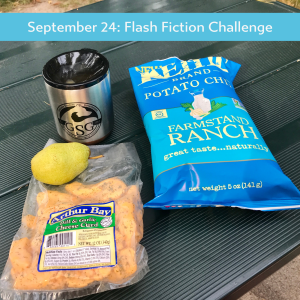
Crunch Time
“I really need this today,” she said.
“Bad day?” asked the waiter, placing the coffee on the table.
“Yeah,” she sighed.
“Coffee’ll fix it,” he said. “I made it myself.”
She smiled, thinking of all the I-made-it-myself gifts received over the years.
With eyes closed, she scooped the delicious chocolatey froth into her mouth.
Then her eyes popped. There shouldn’t be anything crunchy in a cappuccino. She pushed the crunchy bit out on her tongue.
A fly! She spurted the remaining contents of her mouth over the table as a student and parent passed.
“Are you okay?” they asked.
Thank you for reading. I appreciate your feedback. Please share your thoughts.
I can’t think about mice without thinking of Rose Fyleman’s poem in which she states, ‘I think mice are rather nice.’
It’s a poem I’m sure nearly everyone must have learned sometime at school.
While I’m more included to agree with the people Rose says ‘don’t seem to like them much’, they figure in many stories for children and are usually portrayed as cute and adorable.
Even Hush in Possum Magic, one of my favourite Mem Fox picture books, started her journey as a mouse before being editorially transformed into a very cute and very adorable invisible possum.
The three blind mice with their severed tails may not be quite so cute, but really mice are everywhere, as Pussycat confirmed in his report on visiting the Queen.
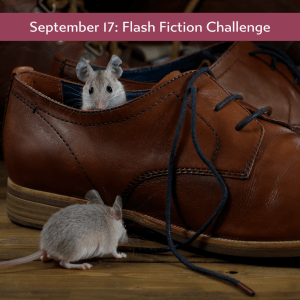
A familiar tale is that of the pet dog eating the homework. But what if it wasn’t the dog, it was mice instead? Would that be more believable? That’s where I’ve gone in response to Charli’s prompt. I hope you like it.
The Mice Ate My Homework
“What happened to your homework this time?”
“It was mice, Miss.”
“I thought you got rid of the mice.”
“We did. In the house. But I left my bag in the car last night.”
“Hmm?”
“The car was in the shed.”
“Should’ve been safe there.”
“It would, except —”
“Except?”
“Tommy forgot to let Rusty out.”
“So?”
“Rusty usually chases the mice away.”
“And?”
“Dad accidentally left the window down. The mice got in and —”
“They ate your homework?”
“They thought it was tasty, Miss.”
“That’s not a smear of peanut butter there, is it?”
“Definitely not, Miss!”
Thank you for reading. I appreciate your feedback. Please share your thoughts.
My response is not a story. It is a reflection on a moment in time. As a child, I loved visiting my aunts, uncles and cousins on their Queensland stations. I hadn’t yet developed an interest in the news or felt it had a significance in my life and was fascinated by the importance it was given in these rural households. It’s understandable when I realise how much their lives were affected by things they couldn’t affect such as stock prices and the weather.
My uncle used to talk to the news report saying things like, “Go on, eh?” or “Is that right?” as if he was in conversation with the reporter. It was very endearing, but it also amused me knowing that the reporter was unable to hear him.
Nowadays, I find myself talking to the television news reporters in less endearing ways when I correct their grammar and terminology. I won’t be able to think of them all now — there’d be too many anyway — but here are three that really bug me:
The use of ‘infer’ when the mean ‘imply’.
Reporting that a vehicle lost control rather than the driver lost control. Until self-drive vehicles are readily available, I think the driver should be in control.
Overuse of the word ‘left’, for example, ‘the man was left injured after the accident’. Surely, he was injured in the accident and not left anywhere. I’d understand it better if he was left on the platform after the train departed.
The radio was important to these outback families in another very special way. Since they were so far from schools, the children were schooled over the radio network with School of the Air and the support of parents or governesses. Many of the families, including my cousins, had special school rooms set up in which to take their lessons. While I loved their school rooms, I never got to see them ‘in action’ as I always visited during the school holidays.
Anyway, I digress. Here is my response to Charli’s prompt.
Tuning In
On sheep and cattle stations in outback Queensland in the pre-television and digital era, when mail and groceries were delivered fortnightly, the party line telephone and radio linked families with the outside world.
Mealtimes were scheduled to conclude with news broadcasts. The chatter and clatter ceased the moment chimes announced the start. Graziers inclined towards the radio, concentrating to extract words from the crackle, hopeful of positive stock reports, promising weather forecasts and news of world events.
Unable to affect, but affected by, the situations reported, the graziers returned to the day’s tasks, hopeful of better news next report.
Thank you for reading. I appreciate your feedback. Please share your thoughts.
I thought it would be easy to write about sunflowers but, alas, I struggled. I finally came up with this story with the theme of diversity, acceptance, belonging and a place for everyone. I hope you like it.
A place for everyone
Rose prickled and turned away from the newcomer. “You can’t blow in here on a breeze expecting to be welcomed,” she whispered to a neighbour.
Sweet Pea belied her name, ignoring the stranger and trailing away to mix with others of her own kind.
Even cousin Marigold wasn’t hospitable, fearing he might spoil their whole bunch.
He didn’t tempt rejection by the glamourous golden Queen outstanding in the field.
Instead, he sailed right by and alighted far from cultivation where his lowly origins wouldn’t raise a brow.
…
“Look! A dandelion! Do you like butter or cheese? Let’s play!”
While many consider dandelions a weed, they actually have many positive uses.
Children love blowing their seeds around and, as the video below shows, physicists learn a lot from studying them.
When I was a child, we used to hold dandelion flowers beneath our chins to decide whether we liked butter or cheese. A lighter refection would indicate a preference for butter. A darker reflection would indicate a fondness for cheese. I don’t think our readings were particularly scientific, but we were always pretty confident of our interpretations.
I was also interested to discover that dandelions, sunflowers, marigolds, lettuce, artichokes and others all belong to the daisy family. Now I’m wishing I did my research first rather than leaving it until the last minute.
Thank you for reading. I appreciate your feedback. Please share your thoughts.
It’s almost spring here in the Southern Hemisphere. The garden is dressing up in blooms of many colours and filling the yard with the sweet scents of wattle, jasmine and other flowers. Bees busily collect the pollen, butterflies flutter from one flower to another, the butcherbirds sing joyously from the treetops, while the cockatoos noisily crack the wattle pods and prune the tree.
Things are starting to feel fresh and new again and encouraging me to emerge from my recent writerly hibernation. While, for the previous six years I’d hardly missed responding to a weekly flash fiction challenge at the Carrot Ranch, I’ve not joined in for the past few months due to the demands of other work responsibilities. I finished that work a couple of weeks ago but have found it difficult to shake off the cobwebs and give creativity some air again. Perhaps spring and this week’s (extended) challenge provides the impetus for doing so.
When thinking of a first flight and spring, how could I not think of butterflies?
One of my favourite things to do with my children in the classroom was to have a butterfly house and observe the magic of all the life stages from egg to butterfly. It was wonderful to have this special little piece of nature up close in the classroom where we could see what you don’t always get to see in the world outside.
Every day we would watch, fascinated, as the caterpillars munched their way through leaf after leaf, growing bigger and bigger. We eagerly awaited the moment they would form themselves into ‘j’ shapes, alerting us that they were about to pupate.
We were amazed at how quickly they shed their last skin to reveal the beautiful chrysalis they had become. Then we would watch and wait until they were ready to emerge as butterflies.
We knew when it was almost time as the chrysalis would become transparent and we could see the wings through the case. When they finally emerged, we would give them time to spread and dry their wings before releasing them into the garden for their first flight.
The growth of a butterfly is a great analogy for creativity or the development of an idea or project. Sometimes a lot of hard work has to be expended before the idea is ready to take flight and the beauty becomes a reality.
Here is my response to Charli’s challenge. I hope you like it.
Dear Butterfly, Love Caterpillar
Dear Butterfly,
You make the impossible seem possible. You inspire our thoughts, our hopes, our dreams. How can I be like you?
Dear Caterpillar,
Dreams create possibilities but now you are exactly who you were meant to be.
Dear Butterfly,
Life is monotonous. Everyone does the same thing, day after day. Shouldn’t life be more than this?
Dear Caterpillar,
Nothing happens overnight. Patience, determination and persistence will reward you in the end.
Dear Butterfly,
I’m tired. I can’t do this anymore. I think I will sleep forever. Goodbye.
Wake up, butterfly. It’s time to spread your wings and fly!
I thought I’d also share a poem that I wrote many years ago in response to an inspector’s visit to our school. As the title says, it is not really about a butterfly and was written long before I became the Butterfly Lady at another school.
I had always believed, and still do, that the children are the most important thing in the classroom and that we do our best for them every day. The teacher next-door wasn’t of the same view. We were in a large teaching space with our own areas separated by some cupboards arranged between us.
She spent a lot of time sitting at her desk, barking at the children to pay attention to her words. She had little of interest on display in the classroom and even less of the children’s own work. It was quite a contrast to my own space which was filled with activity, colour and children’s work.
When the inspector’s visit was announced, she suddenly decided to decorate her room and display children’s work. I was so flummoxed by this, that I was almost tempted to do the opposite. I believed that if what I did on a daily basis wasn’t good enough for the inspector, then it wasn’t good enough for the children either. I resisted the urge to tear everything down in protest (which might have been considered a flight from the situation) and wrote this poem instead.
Before reading it, I want you to know that the teacher and I were both teaching (perhaps I use that word lightly) year two and she was considerably younger than I.
Not Really About A Butterfly
Look at you now.
You put on your show.
Your butterfly colours are warmly aglow.
It’s hard to imagine
That not long ago
You were a mere silent pupa
With nowhere to go.
You flit and you flutter,
Cry, “Hey, look at me!”
And all turn their heads,
Wondrous beauty to see.
But where have you come from?
And how can this be?
Before . . .
Not one head would have turned.
There was nothing to see
— just a little green ball,
curled up on a tree.
Is it dishonest
to change rapidly?
Thank you for reading. I appreciate your feedback. Please share your thoughts.
I haven’t gone with contradiction as much as confusion, but it’s fitting following something I wrote on my readilearn blog last week. In case you missed it, I wrote that being in lockdown has “felt like time has stood still and sped by at the same time”. That’s a contradiction. My story is a confusion.
Upstairs or Downstairs
Granny scratched her head. “I don’t know if I’m Arthur or Martha.”
“Whad’ya mean, Granny? I’m Arthur,” Arthur laughed.
“It’s just an old saying. Means I don’t know if I’m coming or going.”
“But you’re not coming or going. You’re staying here. With us.”
“I know,” laughed Granny. “I’m just a bit confused is all.”
“What’re you confused about?”
“I just came all the way down here for something, and I can’t remember what.”
“But this is upstairs, Granny. Not downstairs.”
“Silly me. There’s not much in my upstairs anymore.”
Now it was Arthur’s turn to scratch his head.
Thank you for reading. I appreciate your comments. Please share your thoughts.
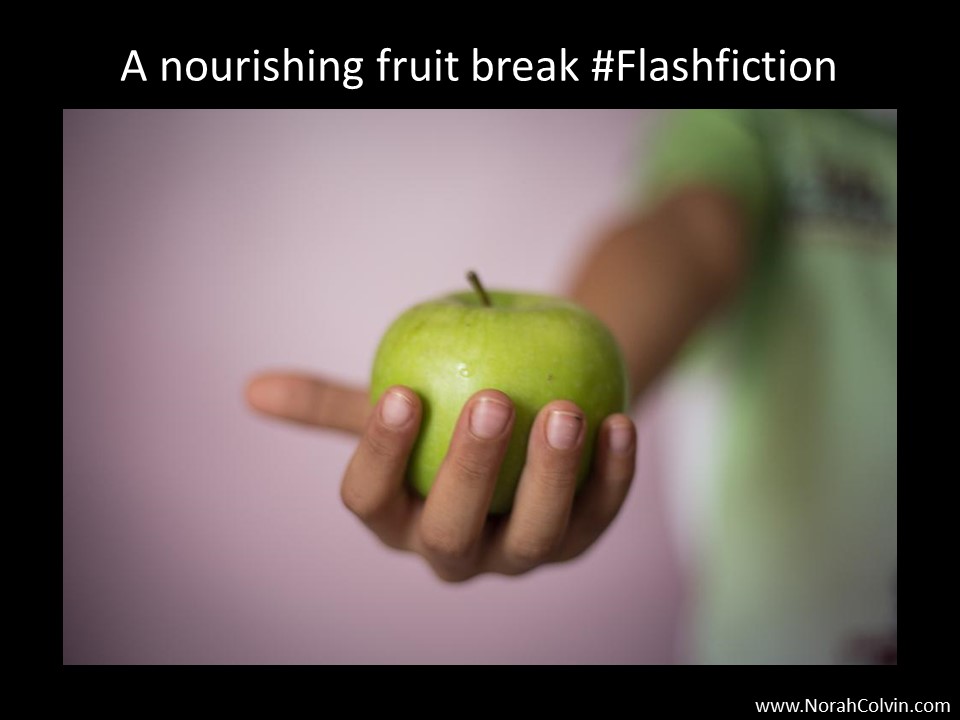
In many schools, children have a 10-minute mid-morning break to have a piece of fruit and engage in some movement activities. It’s often called a fruit or a brain break. Its purpose is to refresh and reenergise for the next part of the session. It is generally welcomed by teachers and students alike. While the fruit may nourish the physical, as my story shows, often other forms of nourishment are also involved. A smile is sometimes all the nourishment a flagging spirit needs, especially on one of those days.
One of those days
The morning hadn’t let up. It began with a “Can I talk to you for a minute?” that stretched into an unresolved 45. Meanwhile, the children swarmed at the door, and the day’s activities hadn’t set themselves out. Her day flipped from organised to ‘fly by the seat’ with one unscheduled meeting. As the minutes ticked away, she hankered for fruit break and recalibration as much as the children. Her apple was a mere millimetre from her mouth when ‘Miss, Ellenie’s crying’ interrupted her. One look told her everything. Ellenie’s grateful smile turned her grey to sunshine. Sanity returned.
Thank you for reading. I appreciate your feedback. Please share your thoughts.
While not really about a character taking charge, as Charli suggested, my thoughts went to the stampede that occurred in supermarkets across the globe earlier this month, and I wondered who had initiated it and how they had achieved such a dramatic result. It seemed to me that it was more suited to an April Fools’ Day joke (that’s tomorrow, folks) than a serious event organised by the March Hare. Not that I would approve of such a joke.
I remember being warned in the early seventies (way back last century) about the use of subliminal messaging in cinema advertising. I never liked the idea that someone could be trying to control my thoughts and actions with subliminal messages. Now, of course, we have social media. There’s nothing subliminal about that and the effect is more immediate and more widespread.
The toilet paper stampede occurred because of a fictional shortage which then became a reality because people were buying in bulk and hoarding it, meaning there was none for anyone else. People seemed to be doing it because everyone else was doing it, regardless of the reassurances we were being given that there was, and never would be, a toilet paper shortage.
This, in turn, reminded me of the story of The Emperor’s New Clothes by Hans Christian Andersen. It has been one of my favourite stories since childhood. I could never understand why people would join in admiring the emperor’s clothes when they must have been able to see that he wasn’t wearing any. However, the very clever trickster weavers pulled the perfect April Fools’ Day joke by telling everyone that only the clever could see the clothes. Who would dare to admit their lack of cleverness? I was always pleased that it was the children who were brave and honest and spoke up to denounce the scoundrels.
So, with April Fools’ Day on 1 April and Hans Christian Andersen’s birthday on 2 April, it seems the perfect time to think about who might be in charge. This is my story. I hope you like it.
Charge!
As if a starting gun had been fired, the children scattered, looking in grass, under rocks, in branches of trees.
“What’re you doing?” asked the playground supervisor.
“There’s eggs, Miss. Easter eggs — millions of ‘em. Enough for everyone.”
“How many’ve you found?”
“None yet. Gotta keep lookin’.”
After a while, the searching slowed. “How many’ve you got?”
They showed empty pockets and empty hands.
The supervisor said, “Who said there were eggs?”
They shrugged.
When the punishment was handed down, the instigators explained, “It was just an experiment to see how many’d be sucked in. We meant no harm.”
I want you to know that this is not a joke: I may join in these challenges only intermittently for the next few months due to work commitments. I may also not get to visit your blogs as often as I would like but know that I will get there as often as I can. Stay well and happy and keep your distance from that awful virus.
Thank you for reading. I appreciate your feedback. Please share your thoughts.
As I mentioned in my comment on Charli’s post, all I could think about was the Fibonacci Rabbit Problem.
I wrote about the Fibonacci number sequence previously in a post called Counting on Daisies.
In the Fibonacci sequence, each number is the sum of the two preceding numbers: 1, 1, 2, 3, 5, 8, 13, 21, 34, 55, 89, and so on.
As the sequence progresses, the numbers get exponentially larger, not unlike the numbers succumbing to the dreaded virus that engulfing our world at the moment.
The number sequence occurs naturally in many situations; for example, in bee populations, in spirals of snail shells, in leaves on plants and petals on flowers.
But who was Fibonacci, why does he have a number sequence named after him, and what is the problem with rabbits?
Fibonacci was the Italian mathematician who introduced the Arabic-Hindu system of numbers and arithmetic (the numbers we use) to the Western World in the 12th Century.
Fibonacci wasn’t his real name. He was really Leonardo Bonacci. His famous book Liber Abaci was handwritten, long before the era of the printing press (let alone computers and indie publishing). A couple of centuries later, some students reading his tome, misread what he had written (‘filius Bonacci’ meaning ‘son of Bonacci’) as Fibonacci and that’s how he’s still known today.
Fibonacci (Leonardo Bonacci) wrote about the number sequence that now bears his name in his book Liber Abaci. He explained the sequence using an example often referred to as The Rabbit Problem. The problem involves rabbits breeding profusely. While the situation described isn’t necessarily accurate, it is entertaining and helps us get the picture.
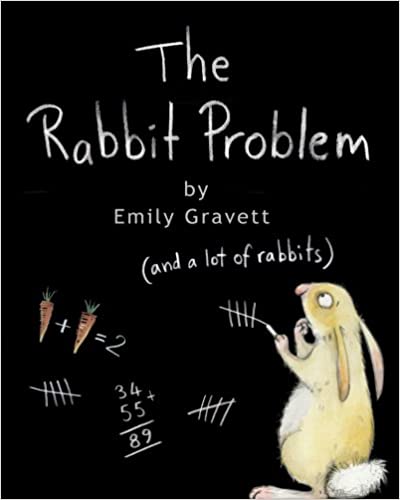
A beautiful picture book by Emily Gravett, also named The Rabbit Problem, is a fun way of introducing the concept to children. Set on Mr Fibonacci’s farm, the rabbits multiply each month for a year according to the number sequence. However, each month, new problems for the rabbits arise.
If you’re interested in finding out more about Fibonacci’s numbers, I highly recommend this video by mathemagician Arthur Benjamin.
But now for my story in response to Charli’s challenge. Perhaps it has an underlying message suited to these troubling times. Maybe you’ll see it too. If not, I hope it’s just a fun story that you enjoy.
What Rabbits?
“Wassup?” He knew something was when she stopped rocking.
“Nothin’.” She continued rocking.
“Musta bin somethin’.”
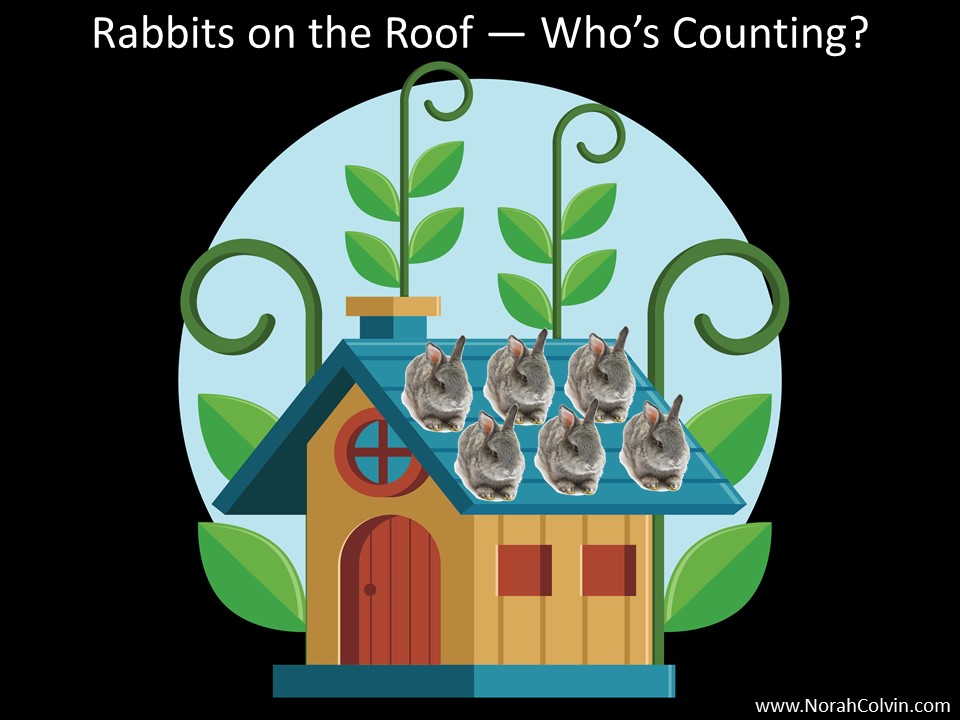
“Nah. Thought I saw a rabbit on that roof, is all.”
“I ain’t never seen no rabbit on a roof.”
“You ain’t never seen nothin’.”
“What?”
“Thought there was two rabbits on that there roof.”
“That’s crazy.”
The rabbits multiplied, but she never stopped rockin’ and she never said nothin’.
One day, he stopped.
“Shhh. I hear somethun.”
“What?”
“Sounds like …”
A multitude of rabbits exploded from the roof, landing all around, even in their laps.
“What?”
“Nothin.”
They kept on rockin’.
Thank you for reading. I appreciate your feedback. Please share your thoughts.
As it usually does, the prompt led me to children and education, especially the empowerment that comes from being able to read. Reading is the key that unlocks the wonders of the world.
While not a continuation of previous stories, it does include some of the characters. I hope you like it.
The Key
Tap-tap-tap, tap-tap-tap.
Peter removed his headphones.
Silence.
He returned to his game. ZING! KAPOW! BOOM!
Tap-tap-tap, tap-tap-tap.
There it was again. Incessant.
What was It? Where was it?
He placed his tablet and headphones on the couch and crept towards the sound — the bookcase!
Tap-tap-tap, tap-tap-tap.
With every step, the tapping intensified. The dusty glass obscured the interior, but the key was in the lock. Should he, or shouldn’t he?
He did!
Into his lap tumbled a rainbow cat, a girl in a hood, a herd of dinosaurs, an Egyptian Pharaoh and all the wonders of the world. Magic!
Thank you for reading. I appreciate your feedback. Please share your thoughts.














 Norah Colvin