Live Love Laugh Learn … Create the possibilities

Category: Affirmations

  • Phrasing praise

    image courtesy of www.openclipart.org
    image courtesy of http://www.openclipart.org

    In response to a previous post the suggestion was made that I compile a list of “yet” phrases that teachers and parents could use to encourage children to develop a growth, as opposed to fixed, mindset.

    Only since I have been blogging have I come across the work of Carol Dweck, a psychologist, who promotes a “yet” mindset. I am very much in favour of the “yet” way of thinking and have shared some thoughts here and here. However I am not yet ready to embrace the whole package.

    I have just listened to Dweck’s book “Mindset: The New Psychology of Success” and it would be fair to say that I am struggling to accept all that she proposes with equal enthusiasm. In fact I find some of her suggestions rather challenging.

    yish, challenge https://openclipart.org/detail/19441/challenge
    yish, challenge https://openclipart.org/detail/19441/challenge

    Previous posts, including the one mentioned above and others linked within it, have led to some very interesting and thought-provoking discussions about praise.  Some involved in the discussion were ready to embrace the idea of praising a child for effort rather than talent. Others could see no harm in bestowing any form of praise on their children and had not felt themselves limited by being praised for their cleverness.

    Dweck suggests ways of encouraging a growth mindset by thinking about what was learned or what could be learned. She says that children should not think they are special just by being, and suggests that if a child scores 100% on a paper the response should be something like, “That was too easy. Sorry for wasting your time. Let’s find something more challenging so you can learn.”

    In the book Dweck shares the experience of replacing her own fixed mindset with a growth mindset. She concedes it is difficult and that regressions can occur. She shares her personal disappointment when, after they had both struggled with a problem for some time, her husband arrived at a solution and she praised him with “Excellent!” or “Brilliant!”. She was crestfallen at her lapse; until her husband explained that he knew she meant that he had worked hard, put in the effort, tried alternatives and finally solved the problem.

    (Note: I am explaining these scenarios in my words not hers. Usually when I have listened to an audiobook and wish to discuss it, I buy the paper or ebook version so that I can quote accurately. I haven’t done that this time as I’m not sure which version is the same, if any, as the audiobook. Throughout this post you are receiving my interpretation or impression. You will need to go to the source for greater detail and accuracy.)

    While I agree that it is important for continual learning to be the goal, I’m not sure that I am opposed to some form of congratulations being given for achievement, as well as effort. Also I think children need to be accepted for who they are, loved and nurtured, without the need to be anything else. I’ve written about that here and here and discussed the use of affirmation songs such as Special as I can Be by Anne Infante. I know it is important to not overdo the “special” bit, but it is also important for them to feel comfortable with who they are.

    Image courtesy of Anne
    Image courtesy of Anne

    Yes, they (we) do need to be encouraged to improve. But surely there is danger in feeling that results are always wanting, that they are never good enough. In fact, in the book, Dweck describes a girl who developed ulcers while striving to fulfill the high expectations she perceived her parents to hold. I think getting the balance right is the tricky bit. Encourage. Inspire. Motivate. But don’t demand, require, stress or, perhaps, judge.

    Somewhere in my recent reading I came across the following “motivational” video, a clip from a movie of which I wasn’t aware. While I don’t wish to misrepresent Carol Dweck and suggest that she would “praise” this method, I think it could be taken as an interpretation (I hope extreme and incorrect) of her philosophy. Have a look and let me know what you think.

    I felt extremely uncomfortable watching this video. I am not a sportsperson so I may not understand the culture of sports training but:

    I felt sorry for the player, Brock, who was pushed to and beyond his “limits”. Sometimes that may be necessary but surely not just to “please” a coach; and this seems to be more about the needs of the coach than the player, “revenge” perhaps for thinking the other team was better prepared (I know it’s just a movie). I was worried that the player was going to have a heart attack and die on the field. I was disappointed that none of his team members intervened to protect him from the bullying coach or to help him with his load. I would definitely find it difficult to work with a manager or coach like that.

    Lazur URH, Lion Tamer https://openclipart.org/detail/218974/lion-tamer
    Lazur URH, Lion Tamer https://openclipart.org/detail/218974/lion-tamer

    While I do not wish to take away from Dweck’s philosophy, many of the examples in her book discuss the mindsets of winners, of champions. Surely not everyone can be a champion. And if you have to push yourself, as Brock did in the video, to do your best, then I’m not sure I want to do my best.

    Some people have described me as a perfectionist. I have never accepted that label. I work hard to do the best job I can, but I also recognise when good enough is good enough. Working within the constraints of resources, including time, imposes limits. Is that a limiting fixed attitude? Maybe I need to work a little more on my growth mindset.

    As for the suggestion of compiling a list of “yet” phrases, I don’t think I am quite ready to tackle that one yet. Besides, I think Dweck has done it herself!

    Mindset explores Dweck’s philosophy more fully. There you can test your own mindset, read some suggestions for Parents, Teachers and Coaches (and other applications) and find out about Brainology, a program written by Dweck and Blackwell to “Motivate students to grow their minds”.

    There is much to explore. I have given but a few snippets here. There is much more learning for me to do.

    Thank you

    Thank you for reading I appreciate your feedback. Please share your thoughts.

  • The expectation of labels


    1 (5)

    In some circles labels can be used as an attempt to define who you are, either to yourself or to others; for example the car you drive, the clothes you wear, the foods you eat, the technology you use, even the books you read. The use of labels can lead to stereotyping and expectations based upon particular characteristics while other, and equally salient, qualities specific to the individual are ignored.

    Applying labels to children can serve similar purposes: to define and explain particular behaviours or characteristics. Labels can range from an informal “naughty” through to medical diagnoses such as ADHD (Attention Deficit Hyperactivity Disorder) or ODD (Oppositional Defiant Disorder).

    Whether the result of an informal observation or a professional assessment, labels can have a profound effect upon a child and family members. The label sets up expectations that may limit the way the child is viewed; so that only those characteristics specific to the label are noticed and responded to. The child is viewed as being “the label” rather than an individual who displays those particular behaviours or characteristics, at this moment.

    People tend to see what they want to see and ignore evidence that doesn’t support their thinking. So if a child is labelled disruptive, it is the disruptive behaviour which is noticed and acted upon. Similar behaviour in a child not bearing the label may be overlooked or excused. While the focus is on one, usually negative or limiting, behaviour other positive characteristics and strengths may be ignored.

    pygmalion effect

    Unfortunately, once a label is applied it is often difficult to remove and it may be used as an excuse for a child’s failure to learn or progress; after all the “fault” is considered to be with the child, not with any methods used or not used. Sadly too, labels can be misapplied or not fully understood. This may accentuate differences that are non-existent or less serious than the label implies.

    However not all effects are negative. There are many positive effects of labelling a child’s condition or behaviour; including:

    • increased opportunities for the child, family and teachers to receive support through funding of programs, assistance of trained personnel and professional development
    • enhanced understanding through discussions using a common language with specific meanings and applications
    • increased awareness in the community with further opportunities for advocacy as well as greater acceptance and tolerance
    • the development of programs aimed specifically to support individuals with the condition.
    rg 1024, gift https://openclipart.org/detail/31159/gift
    rg 1024, gift https://openclipart.org/detail/31159/gift

    But are all labels negative? What about giftedness?

    Previously on this blog there has been some discussion about praise and the effects of different types of praise. The discussions were initiated in response to The Examined Life by Stephen Grosz and can be found here and here. Grosz suggested that praising a child could cause a loss of competence. Why would you continue to try if you were already “the best”?

    Claudia M. Mueller and Carol S. Dweck support the notion that Praise for Intelligence Can Undermine Children’s Motivation and Performance. They suggest that labels such as “smart”, “clever” and “intelligent” can be just as damaging as those with deficit connotations.

    Dweck explains her ideas more fully in Mindset: The New Psychology of Success, my current audiobook “read”. I have previously mentioned Dweck’s theory of ‘yethere and here.

    In the book Dweck talks about how praise creates mindset. If one is praised for being smart or clever, then one develops a fixed mindset: “I am smart. I can achieve because I am smart.” If effort is required then one is not smart. Those with a fixed mindset avoid challenges that might jeopardise the view of themselves as smart.

    On the other hand, praise for effort encourages a ‘yet’ or growth mindset: if I try it again, try harder, try it a different way, then I will do better. “I can learn”. There is no risk of becoming ‘not clever’. A growth mindset recognises the importance of effort, persistence and motivation.

    fixed - growth mindset

    Dweck says “don’t praise the genius – praise the process”.

    Giftedness” is a label that was once applied after achieving a high result on an intelligence test, and was just as sticky as any other: there for life.  Giftedness was considered stable and unchangeable. It is obvious that many “gifted” students could fall into the fixed mindset trap. Thanks to Dweck’s work on mindset, attitudes to IQ scores and the concept of “giftedness” are now changing.

    Teachers with a growth mindset appreciate the incremental

    Students can be encouraged to develop a growth mindset by learning about how the brain works. When they understand that labels aren’t fixed and that learning can be improved, they will become more confident and may find more enjoyment in some of the challenges that school offers. Encouraging students to recognise how they view themselves as learners and to substitute “growth” for “fixed” thinking will have a remarkable effect upon their confidence and success.

    Encouraging this growth mindset may be one way we can look out for each other, one way of “getting your back”.

    To write a story (in 99 words, no more no less) about a character who is called to have the back of another was the challenge set by Charli Mills at the Carrot Ranch this week. In her post Charli is talking about labels of another kind, labels that can be just as damaging or just as useful. She talks about having another’s back, being there to offer support when needed.  A parent, a teacher, a friend can be there at any time to offer support for a learner on their path to discovery. My response captures one such moment.

    Growth: a mindset

    Marnie propped her head on one hand while the pencil in the other faintly scratched the paper. She hoped it wasn’t too obvious that she didn’t get it. But she didn’t get it. She didn’t get last year, or the year before. Why should she get it now? What was the point? Her brain just didn’t work that way. She was dumb. They had always said she was dumb. No point in trying.

    Then the teacher was there, encouraging, supporting, accepting. “Let me help you,” she said. “You can do this. Let’s break it down into steps. First …”

    Thank you

    Thank you for reading. I appreciate your feedback. Please share your thoughts about any aspect of this post or flash fiction.

  • S.M.A.G. is here!

    writing

    In just a couple of months it will be two years since I started blogging. Writing a blog had never been a goal of mine. In fact it would be fair to say that until I started blogging I didn’t have much of an idea of what it was; or of any social media platforms for that matter. I was a latecomer to the party considering, according to Wikipedia, blogging began in the 1990s!

    My goal at the time of beginning blogging was, and still is, to set up a website of educational resources for use in early childhood classrooms or homes. The main message I received when attending a writers’ seminar about digital publishing was the importance of having an “online presence”. I took the advice and started tweeting and blogging.  Here I am now, a semi-experienced tweeter and blogger, still a bit unsure about the online presence.

    tweet bird

    I started blogging with a goal of posting twice a week, which I have pretty much maintained since then. Initially I had just few readers, all of whom were “real” people, family and friends, I already knew. As much as I was, and am, very grateful for their continued support and encouragement, it was very exciting to receive my first “outside” comment two months later.

    It was over four months before any new readers visited and commented regularly. Some of those first readers are still with me (Anne and Caroline), others have moved on, and others have since joined. Now I have a wonderful group of online friends. As with offline friendships we interact when we can, exchanging comments and ideas with each other, mostly on our blogs and Twitter.

    https://openclipart.org/detail/117199/Friendship
    https://openclipart.org/detail/117199/Friendship

    I have been as fortunate with my online friendships as I have with my offline friendships. (I was tempted to use the word “real” instead of “offline”, but I consider my online friendships no less real.) We don’t have to see each other every day, every week, or even every month, for the friendships to flourish. Wherever the friendships form, they require certain ingredients to keep them strong, including:

    respect, acceptance, attention, appreciation, gratitude, and open communication that goes both ways.

    I really appreciate people who challenge and extend my thinking as much as those who are happy to jump on my bandwagon with me, or just come along for the ride.

    Gerald_G, Kids wagon https://openclipart.org/image/800px/svg_to_png/40459/Kids-Wagon.png
    Gerald_G, Kids wagon https://openclipart.org/image/800px/svg_to_png/40459/Kids-Wagon.png

    During the past few months when some of my blogging friends and I have been sharing appreciation for each other and our comments, I have suggested that we belong to S.M.A.G.: The Society of Mutual Appreciation and Gratitude.

    It started off in a light-hearted way (yes, I coined it) but others seemed to appreciate the thought and welcomed the idea of belonging to a group that required of them no extra effort. I decided that a S.M.A.G. badge to be displayed by anyone who wished was in order.

    In a previous post, I discussed the need for Making choices in how I allocate my use of time while working towards achieving my goals (including posting twice weekly). I shared thoughts about using a contest on 99designs to obtain illustrations for some of my work. While I was very happy with the illustrations, I was a bit uncomfortable with the contest process. However I decided that engaging each of the three runner-up finalists to do other illustrations in a guaranteed one-on-one project would (in my mind) help, in a little way, to make up for all the work they had done without reward. I have since done this and feel much happier about the process and am pleased with the results.

    One of the designers, Kari Jones (ArtbyJonz), is now illustrating a second book for me and I approached her for the S.M.A.G. badge. This is what she produced. I love it. I hope you do to.

    SMAG ccbyncnd

    If you would like to display it on your blog, and share it with your blogging friends, I would be honoured for you to do so, but please attribute it to me and link back to this page.

    I have found Kari wonderful to work with. She has been very helpful and accommodating and I am delighted with the artwork she has produced for me. If you are looking for illustrations I am happy to recommend Kari. You can check out some of her other work on her ArtPal page and contact her on Facebook if you have any queries.

    So thank you, all my friends, for your continued support and readership. Whether or not you choose to post the badge, you are still part of S.M.A.G. and it is a pleasure knowing you.

    Thank you

    Thank you for reading. I appreciate your feedback. Please share your thoughts about any aspect of this post.

  • A garden party

    www.openclipart.org
    http://www.openclipart.org

    The purposes of education are many; but perhaps one important purpose of “free” public schooling is to ensure that everyone is provided with the opportunity of being educated. While this goal is achieved to a certain extent, inequalities of opportunity still exist, many of which are related to socioeconomic status (SES).

    letter from Camus

    While there is no doubt that a teacher can have a powerful effect upon the lives of students and any teacher would love to receive a letter such as that written by Albert Camus, socioeconomic status is often considered to be the most reliable predictor of success in school and, therefore, in life. There are many reasons for this, few of which have anything to do with intelligence.

    www.openclipart.com
    http://www.openclipart.com

    According to Macquarie University the majority of students in tertiary education are of mid to high socioeconomic status. The parents of these students may have professional backgrounds and may have attended tertiary institutions themselves.  Most have an appreciation of the benefits of higher education and are able to continue supporting their students, to some extent, while they study.

    While students of lower SES are attending tertiary institutions in greater numbers they are disadvantaged in doing so by a number of factors, primarily financial in origin. Although Australia is supposedly free of class distinctions, attitudes towards those from lower SES areas are often demeaning and unsympathetic. Students from these areas may battle to develop the self-esteem that seems to be a birthright for others from more privileged backgrounds. The negativism with which they are viewed, and some come to view themselves, can become a self-fulfilling prophecy.

    Ready for school - year 2
    Ready for school – year 2

    I was a fortunate one for, while I grew up in a family with low SES background, my parents saw the value in education and sacrificed much for their children to have the opportunities it provided. The high costs of tertiary education that are now incurred could not have been afforded, but I achieved well enough in school to obtain a scholarship to teachers’ college and a three-year bond (guaranteed employment) when that was finished.

    Nowadays there is no such thing as guaranteed employment and few scholarships. Many families cannot afford to have post-secondary/adult students continue to live at home and not contribute to expenses while they undertake further study. This means that students have the additional burden of working while they are studying. Many opt out of study altogether to seek long term employment, often in low paying jobs with little opportunity for advancement. And so the cycle continues. The lack of permanent employment even for graduates makes deferring earnings less desirable again.

    caravan

    Of course the disadvantage doesn’t just begin when approaching final years of school. The impacts can be observed from the earliest age. (My suggestion for an early learning caravan addresses this in part.) Although education is provided “free” to students, there are many other associated costs that families may struggle to meet, such as books, equipment, and extra-curricular activities such as excursions and incursions.

    In most Australian schools, the wearing of uniforms helps to minimize differences that may otherwise be obvious by choices of clothing and footwear. It also helps to reduce costs. Sometimes additional activities can be a drain on family expenses, and while many schools will fund expenses for those in need, not all families are willing to ask for that help.

    DCF 1.0

    Studies have shown that many children arrive at school without having eaten breakfast. While this phenomenon can occur in any family, it is more prevalent in low SES areas. Some schools are now providing a healthy breakfast for students when they arrive at school. I think this great as hungry children tend to have difficulty concentrating and learning, are often lethargic and may suffer from mood swings and negative attitudes. I know how irritated I become when I am hungry. My family “joke” about not getting in the way of me and my food! How much worse for children who come to school with empty bellies.

    Of course these issues are compounded for children who live in dysfunctional families. As much as we may try to be inclusive and equitable in the way we treat them, these students are often the ones who notice their differences and inadequacies and become most self-critical. It can be a very difficult task to change the attitudes and habits of generations.

    This week at the Carrot Ranch Charli Mills talked about attending a garden party. The hosts and guests at this party had obviously enjoyed some of the finer things that life reserves for a few.

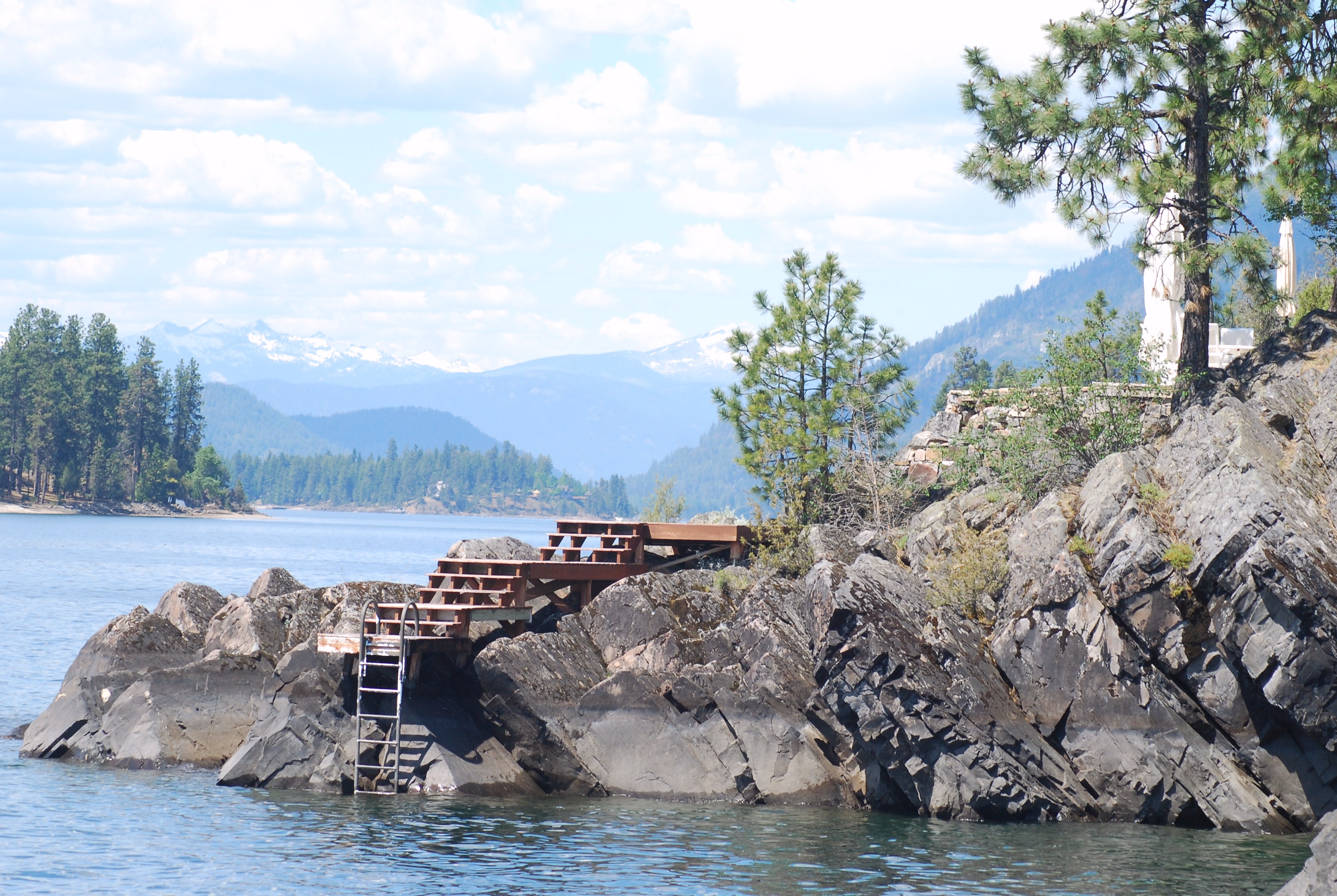
    lake-pend-oreile-cruise-may-21-31

    Charli shared a photo of a rather idyllic spot on an island and challenged writers to In 99 words (no more, no less) write a story, using the above photo as a prompt.

    Well the photo is beautiful, but I couldn’t get away, I was stuck at the garden party. I thought it was a wonderful analogy for the rewards that can be had from an education; rewards that may be obvious and perhaps available to many, but rewards that may be out of reach to others because of circumstances over which they have no real control. I thought of Marnie who suffers the double disadvantage of a dysfunctional family in a low SES area; but who knows there is something better out there and wants it for herself.

    Thanks to Charli for her prompt, here is another episode from Marnie’s life. I hope you enjoy it.

    The garden party

    Marnie’s face pressed into the bars of the tall white gate with amazement: white-covered tables laden with food; chairs with white bows; white streamers and balloons; and a band!

    But the ladies had her spellbound with elegant dresses and high, high heels; flowers in their hair and bright painted lips.

    A man in uniform opened the gate to guests arriving in limousines. Marnie followed.

    “Not you, Miss,” said the uniformed man.

    Marnie held out her invitation, “Jasmine . . .”

    But he’d closed the gate and turned away.

    Marnie looked down at her stained dress. What was she thinking?

    Thank you

    Thank you for reading. I appreciate your feedback. Please share your thoughts about any aspect of this post or flash fiction.

  • How important is it, if it can’t be tested?

    A+

    This week, all across Australia, students in years 3, 5, 7 and 9 took part in the National Assessment Program NAPLAN.

    In previous posts I have questioned the purpose of this type of assessment, the importance placed upon the results, and the undue stress caused to students, teachers and families. You can read some of my thoughts here, here and here for starters.

    Of course I am not the only one questioning, and Australia is not the only country in which nation-wide testing is set, and questioned. The tests are no more popular in the US with many students opting out. Diane Ravitch does much to raise awareness of the issues on her blog. Concerns are also raised in the UK, and no doubt elsewhere.

    However sometimes something good can arise where it is least expected. Out of the melee of the testing environment this week came a wonderful letter written to students by teachers who know that there is more to each one than the score on a test. A parent of one of the students posted the letter on Facebook and it went viral. The story was picked up by a variety of media outlets.

    I congratulate the teachers for writing and distributing the letter. I couldn’t have said it better myself.

    Check it out on Facebook here, or read some of the media reports:

    ABC Brisbane

    Daily Mail UK

    The Independent UK

    A similar letter went viral in the UK last year, and according the ABC article, the letter was based on one written to students in the US a number of years ago. I don’t think the message can be repeated often enough.

    Maybe it is one thing to tell the students, but how do we get the policy makers first to listen and then to act?

    Perhaps they should have a listen to the discussion by Tim and Debbie, one of my favourite pieces from the 80’s.

    Actually, in relation to the letter, I was looking for one of my favourite quotes by Tim but sadly couldn’t find it. He says, “My thoughts exactly. I would have said it if I’d thought of it!”

    Thank you

    Thank you for reading.

    I appreciate your feedback. Please share your thoughts.

  • Bully for you!

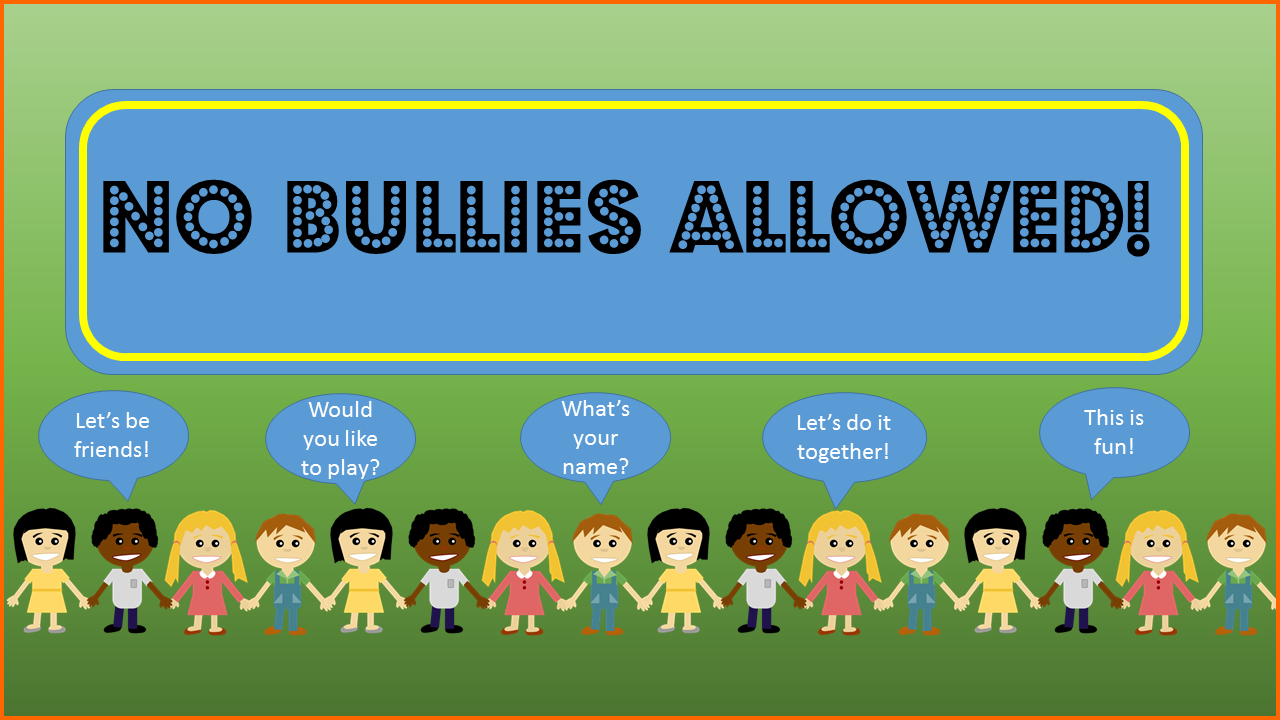
    No bullies allowed

    Everybody knows what a bully is. If you have never experienced bullying of some kind on a personal level, then you are probably pretty lucky. But you have possibly witnessed, or were at least aware of, bullying at school, in the community, or in the workplace, maybe even at home.

    https://openclipart.org/detail/27915/Thug
    https://openclipart.org/detail/27915/Thug

    Bullies feature strongly in traditional fairy tales such as the stepmother and stepsisters in Cinderella and the mean Rumpelstiltskin in the story of the same name. Roald Dahl also introduced us to bullies through Veruca Salt in Charlie and the Chocolate Factory and Mr and Mrs Twit in The Twits.

    The first picture books I think of when the topic of bullying is raised are Anthony Browne’s Willy the Wimp and Willy and Hugh. They are great to read and use to stimulate discussion of bullying with young children. In this video author Anthony Browne explains that most children recognize a little of themselves in Willy. The transformation from timidity to self-confidence appears achievable and encouraging to all.

    The opposite of being a bully is being kind. This article by Kari Kubiszyn Kampakis, Raising a Kind Daughter tells a heart-warming story of selfless kindness shown by a daughter and her mother. As was commented on in many posts about compassion, including this one, modelling is the best way of teaching children attitudes and behaviours we wish them to learn.

    This week at the Carrot Ranch, Charli Mills has challenged writers to In 99 words (no more, no less) write a story that shows the bully mentality countered with a different, unexpected or kind action.

    Over the past year while I have been engaging with Charli’s flash fiction challenges, I have been developing a character, Marnie, who is definitely no stranger to bullying. Each of Charli’s prompts encourages me to think a little more about Marnie, what may have occurred in her life, and what her responses would be. While I sometimes write about other things, I could not ignore Marnie with this prompt.

    This is what we already know about Marnie,

    as a child:

    • she has a dysfunctional family
    • she suffers physical and emotional abuse, including neglect, from both parents
    • she has a toy unicorn as a comforter
    • she finds the expectations of school challenging
    • she feels alone and excluded at school with few friends
    • she gains the support of one teacher who helps her to develop more self-confidence

    as a teenager:

    • the teacher continues to support her
    • she leaves home and breaks contact with her family

    as an adult:

    • when both her parents have passed she is contacted and returns to the family home, which she sells, relieved that there is no longer any chance of abuse such as occurred in her childhood

    There are still many gaps and unknowns which I am hoping to explore in more detail in the future. In a recent discussion with Charli, I commented that each time I write about Marnie she reveals a little more, in much the same way as she would reveal herself to a new friend or a therapist. I’m thinking she may need to talk to a therapist at some stage. I might need to see who, and what, Anne Goodwin would recommend!

    I hope that somewhere in her life, Marnie has a friend like Annie, described in the article by Kari Kubiszyn Kampakis. Maybe it is Jasmine who we have already met in a previous episode, which also touched on a situation which may have involved bullying. Please let me know what you think.


    https://openclipart.org/detail/117199/Friendship
    https://openclipart.org/detail/117199/Friendship

    Not funny at all!

    Jasmine and Georgie rushed towards the cluster of children who were laughing hysterically at something unseen. They expected to see an entertainer performing magic tricks. Instead they saw Marnie, face down in a puddle, reaching for her unicorn; sobbing.

    “Good one, Brucie!” Two boys high-5ed. Another called, “Way to go!”

    The children stood transfixed by the spectacle. Jasmine pushed through. She picked up the muddied unicorn, stretched out a hand to help Marnie up, then put an arm around her waist,

    As she led Marnie away Jasmine glared at the group of disbelieving faces.

    “Shame on you,” she mouthed.


    Thank you

    Thank you for reading. I appreciate your feedback. Please share your thoughts about any aspect of this post or flash fiction.


  • I’ve got the music in me – let me count the ways!

    I’ve got the music in me – let me count the ways!

    For any hearing person, music is integral to our lives.

    Every country has a national anthem which may be taught in schools and played or sung at many and varied ceremonies and occasions, inspiring unity and national pride. Many other organisations such as schools and colleges have their songs praising their strengths and fostering a sense of identity. Couples have their special or ‘theme’ songs.

    When we enter a store we are serenaded with music chosen to make us feel comfortable and entice us to stay longer and buy more.

    Joyful advertising jingles with their subliminal messages encourage us to memorize the product name and make it our next purchase. These jingles can stay in our heads for years, like this famous one about Louie the Fly:

    A few bars of a song can revive memories from long ago. I have written about this previously in a flash fiction piece, Vagaries of time.

    Music can call us to dance, to relax, to sing, to cry. It can be chosen to match our mood, or can help to create a mood or atmosphere. The soundtrack of a film or television show tells the audience what to expect and how to feel.

    Music is also an integral part of education and learning. Learning information in a song can help one remember. Many people like to have music playing when they are reading or studying. I did when studying towards my high school exams, but now I prefer quiet when I write. Programs such as Accelerated Learning recommend using Baroque music to help learners stay relaxed and focused, increasing retention.

    I have previously written about using songs in the classroom, such as I love the mountains which I learned from Bill Martin Jr. and affirmation songs such as those of Anne Infante here and here.  I have also composed class songs and chants such as Busy Bees chant, and used songs to support class work, for example The Ugly Bug Ball when learning about mini-beasts.

    I have used music to calm and settle after play breaks, and music for activity between seated activities. I used songs in the morning to signal to children that it was time to be ready for the day’s learning, including action songs or songs about our learning, for example a phonics song:

    Image courtesy of Anne
    Image courtesy of Anne

    But of course, once we were settled, every day started with an affirmation song, or two. It got everyone into a happy expectant mood. It’s hard to be sad when singing (unless it’s a sad song).


    image courtesy of www.openclipart.org
    image courtesy of http://www.openclipart.org

    . . . and  songs in the afternoons to send the children home happy and singing with joy.

    As a year level we would sing songs to settle the children when lining up to return to class after lunchtime play. The children hurried to join in and sang their way joyfully into class. This is quite different from when I was at school and we would line up in silence and then march into school in step, subdued and quietly obedient.

    I composed songs as a child but did not continue the practice as an adult, except for one: a lullaby that I sang to soothe my baby girl to sleep. A few years later I decided to learn to play the keyboard from a very talented musical friend who guided my writing of the accompanying music. This remains my one real musical accomplishment!

    For someone who does not consider herself at all musical I certainly enjoy, and promote the use of, music in many different ways.

    On that note, I leave you with my flash fiction response to the prompt set by Charli Mills of Carrot Ranch Communications: In 99 words (no more, no less) write a story influenced by a musical score.

    Final act

    A collective gasp interrupted the music mid-beat.

    All eyes turned synchronously, as if worked by unseen strings, towards the French doors, burst open and revealing a silhouetted figure framed by billowing gossamer-like curtains.

    Out of the darkness the figure emerged: clothed in black with coat tails flapping, a top hat in one hand and a white-tipped cane held aloft in the other.

    The conductor revived the orchestra as the figure glided across the floor, seized the heroine decisively and whirled her around and around.

    The spell now broken, the cast joined in the dance to tumultuous applause.

    I hope you can imagine the score that would be written to accompany this piece and its change of moods.

    What score would you give it?

    Thank you for reading. I appreciate your feedback. Please share your thoughts about any aspect of the article or my flash fiction piece.

  • The Very Inspiring Blogger Award – Acceptance

    The Very Inspiring Blogger Award – Acceptance

    birthday-cake-25388As a birthday gift to me (though he didn’t know it was my birthday) Geoff Le Pard, who blogs about the Universe and whatever occurs to him at TanGental, nominated me for the Very Inspiring Blogger Award.

    Needless to say I was both surprised and delighted. I could say that I aspire to inspire, but I think even that would be a great exaggeration.


    In his post Geoff provides three reasons for selecting me:

    • I see life through a prism
    • I have a firmly fixed moral compass, and
    • He wishes I’d taught him at school!!!!!

    The first two I am not sure about, but I am definitely honoured by the third. Thank you Geoff. I will endeavour to attain this high bar you have set.

    The rules for accepting this award are:

    1. Thank and link to the amazing person(s) who nominated you.

    2. List the rules and display the award.
    3. Share seven facts about yourself.
    4. Nominate 15 other amazing blogs and comment on their posts to let them know they have been nominated.
    5. Optional: Proudly display the award logo on your blog and follow the blogger who nominated you.


    Thank you, Geoff. I am honoured.

    These are seven things about me:

    1. I am passionate about education and the power that education has for transforming lives. I believe that everyone has a right to an education. I have spent all of my adult life involved in education in some way; and most of my childhood was spent in school!

    2. I am the third of ten children. What that tells you about me I’m not sure, but I believe we are more than the product of our birth order and environment; that each of us has the power to make choices about how we want to live our lives. I’m not saying environment and genetics don’t play a large role in who we are, but I am saying they do not determine everything.

    3. I have two adult children of whom I am extremely proud and who I love very much. They are what is important in my life. They each have a wonderful partner who I also love, and my son has two beautiful children who I adore. My family gives me an enormous amount of pleasure. I am very fortunate to have all of them living close to me.

    4. I enjoy playing games, especially word games like Scrabble, Upwords and Balderdash. I especially enjoy playing them with my family. We often spent days playing games together when the children were growing, and had grown, up. We’re having a bit of a rest now that the grandchildren are small and doing the entertaining. I’m sure we’ll have three generations playing together again soon. We collaboratively do the ‘Big Quiz’ (40 trivia questions) in the local paper when we get together on Sundays, hoping that someone in the family may know the answer. None of us fair too well on the sporting questions!

    5. I have a silly sense of humour. I enjoy word plays and puns and alternate meanings for words and sayings. In my head I finish words and statements with ridiculous things before the person speaking has even time to finish them. I laugh uncontrollably at something I think is funny, like this silly senior’s password email that arrived in my inbox this week:

    windows

    6. I think life is short and should be fun. We don’t know how much time we have so we should enjoy what we’ve got. This doesn’t mean we have to be out partying and playing all the time. It means we need to focus on enjoying what we are doing in the present moment, no matter how unpleasant it may be. It also means making choices and accepting responsibility for the choices we make.

    7. I love learning. Learning gives so much joy. There is too much to learn in one life time, and it is scary now that the road ahead is considerably shorter than the one already travelled. I hope that in my days of teaching I have inspired in children a love of and joy in learning that they will carry with them throughout their life travels.

    Nominating 15 other amazing bloggers is the hard part. Not because there are not 15 amazing and inspiring bloggers, but because I have nominated many before for a Butterfly Award, a Versatile Blogger Award and a Liebster Award. Not only that Geoff has nominated many of these same bloggers for this award, and Charli Mills has nominated them also.

    We have a wonderful community of very supportive and encouraging bloggers. We each write our own blogs about our own interests, explaining our ideas and points of view. We read and comment on each other posts sharing points of convergence and divergence, and often adding further insights.

    Rather than re-nominate bloggers I have nominated before (and be assured that you are all very deserving of this award and if you wish to add the Inspiring Blogger’s badge to your blog I am happy for you to do so) – over the next few weeks I am going to do a little more exploring to seek out other inspiring bloggers to add to our growing community.

    A big thank you, to each and every one of you, for encouraging and supporting me on my blogging journey. Having your company is what makes it all worthwhile!

    I appreciate your feedback. Please share your thoughts on any aspect of this article.


    Previous nominees:

    Liebster Award

    Belinda Pollard of Small Blue Dog Publishing (Australia)

    NANNY SHECANDO (Australia)

    Anne Goodwin (UK)

    Caroline Lodge (UK)

    PS Cottier (Australia)

    Teachling (Australia)

    Peter Worley’s philosophy foundation (UK)

    Michelle Sowey at The Philosophy Club(Australia).

    There’s No Food ( Australia)

    Obscure Pieces (Australia)

    Cultivating Questioners (USA)

    Nillu Nasser Stelter (UK)

    Charli Mills Carrot Ranch Communications (USA)


    Versatile Bloggers

    Ailish Sinclair

    Teagan Kearney

    Karen Wyld

    Vicki Addesso

    Susan Buchanan

    Paula Reed Nancarrow

    Lisa Reiter

    Lori Schafer

    Karen Oberlaender

    Diane Mott

    Greg Mischio

    Anne Goodwin

    Caroline Lodge

    Charli Mills

    NannySheCanDo


    Butterfly Award

    Ruth Mancini

    The Nerdy Book Club

    Two Writing Teachers

    Raising a literate human


  • Are you ready to embrace the future?

    http://openclipart.org http://goo.gl/XApwuV
    http://openclipart.org http://goo.gl/XApwuV


    The flash fiction challenge posed by Charli Mills at the Carrot Ranch this week deals with the future. What a perfect prompt for a teacher, for is not education firmly focused on the future?

    We educate ourselves so that we will know more, be more skilled, or be able to do more in the future than in the past; we may learn new skills that keep us up-to-date with the changing demands of society or technology; or we may seek to improve our employability or income possibilities.

    We educate our children so that they will be independent and contributing members of society, able to participate in the world of the future, and having the knowledge and skills to enable them to achieve their goals.

    We educate for the future, but we are unable to predict the future, so the challenge to making decisions about education is difficult and highly-charged, attracting many different opinions and suggestions for solutions.

    Forbes Magazine featured an article in 2012 which queried the purpose of education.

    A 2013 TED conversation about the purpose of education, related to a talk by Ken Robinson, Changing education paradigms, attracted many and varied comments.

    In 2014 Tony Ryan hosted an online seminar about Future-proofing Kids. Tony says,

    “Many of the children alive today in Western societies will still be around in the 22nd Century. How can we possibly predict what they will experience between now and then? And if we can’t do that, then how do we best prepare them for whatever is up ahead?”

    I think of greatest importance in preparation for life, all of which will be in the future, except for the present moment, is the development of attitudes and character traits including:

    •  Confidence
    • Persistence
    • Resourcefulness
    • Resilience
    • Able to seek solutions to problems
    • Openness to new ideas and possibilities
    • Creativity
    • Divergent thinking
    • Questioning
    • Optimism

    In addition to the character traits, a certain level of skill is required in both literacy and numeracy, and especially an ability to locate and critically evaluate information.

    The title of Tony Ryan’s seminar, Future-proofing Kids, to me belies the value of the content Tony shares. To me ‘future-proofing’ indicates that the future is something to be protected from, like water proofing protects us from water; something perhaps of which to be scared. But Tony’s seminar is far more optimistic and future-oriented than that.

    We don’t know what the future will bring, but we never have. We can plan for it, we can hope and dream and set goals; but we can make no guarantees. Prophesies have never accurately foretold the future. I’m thinking of George Orwell’s Nineteen Eighty-Four or the more recent Y2K Bug.  I’m thinking of all the teachers who told their students they would never amount to anything, like Thomas Edison’s teachers who said he was “too stupid to learn anything”.

    peole_laptop

    In the early 1980s I was told at a conference that by the year 2000 computers would do so many of our menial tasks that we would have an enormous amount of free time and wouldn’t know what to do with ourselves! How inaccurate was that prediction! The menial tasks have only increased in number and instead of computers being a tool to simplify our lives, in teaching anyway, they are now an unrelenting, ever-increasing and demanding master requiring the completion of data bases and spreadsheets, the creation of graphs and statistics, reducing life to a series of expected numbers and standards

    The potential employment opportunities of today’s young women could not even be imagined when I was growing up and making my work choices. My apparent choices were teacher, nurse or office worker, and ultimately mum. Because I had chosen an academic path after year 8 and hadn’t learned shorthand and typing, office worker was eliminated. If I had chosen the commercial, shorthand and typing, path my choices would have been even further restricted.

    My generation was the one that began shuffling the female role in society. Had I been born just a few years earlier, I would have worked until I married; after which I would have stayed home and looked after the children. Many female teachers were required to resign when they married. Pregnancies were hidden under loose and voluminous clothing, and the whole process was considered an illness. Unmarried mothers were considered an embarrassment and ‘sinful’ and most had their babies removed and that part of their history hidden.

    Women of my era were able to return to the workforce, but it was not encouraged before the youngest child had started school. At that time child care was not readily available and often grandmothers, who had not returned to the workforce after marriage, looked after the children for mothers who worked, often part-time and for low wages.

    The current generation of women have far more career opportunities but are also expected to stay in the workforce, often required to return to work when their babies are only a few weeks old in order to maintain security of employment. Many now work through pregnancy, almost until the birth of their baby.

    Pregnant women no longer try to hide under voluminous layers of clothing but, partly with thanks to Demi Moore and Annie Leibovitz in 1991, take pride in showing off their changing shape. The term ‘unmarried mother’ is almost an anachronism in today’s Western world. There is no shame in having a child, whether married or living with someone or not; and babies are not forcibly removed from their mothers.

    I am no more able to predict the future than I am to make sense of the injustices and horrors of the past.  However I think part of the purpose of education must be to help individuals grow so that they are able to stride towards the future with arms outstretched saying, “Give me what you’ve got!” while at the same time with a listening ear and an open heart asking, “What can I do to help?”

    What do you think?

    I welcome your feedback. Please share your thoughts about any aspect of the article or my flash fiction piece:

    Ready

    I’m off now,” she said.

    “Have you got everything?” asked Mum.

    Yes Mum.”

    “Are you sure you haven’t forgotten anything?”

    I’m sure.”

    Mum looked around. There must be something she’d missed.

    “What about . . .?”

    No, Mum. I’ve got everything.”

    “Okay. If you’re sure.”

    “Bye Mum!”

    ”Bye.”

    She walked through the door and down the stairs.

    Mum watched, anxious. What could she have forgotten?

    “Wait!”

    She turned, puzzled.

    Mum leapt down the stairs.

    “What?”

    Mum hugged her tightly, whispering softly, “I love you very, very much. Always have and always will.”

    “I know. Love you too Mum.”


  • What do you have in mind?

    This week Two Writing Teachers posted a wonderful article by Stacey Shubitz (one of the Two Writing Teachers) about A Picture Book that Pushes the Growth Mindset.

    This post coincided beautifully with the flash fiction prompt posted by Charli Mills at Carrot Ranch Communications. Charli’s challenge is to:

     In 99 words (no more, no less) write a story about getting stronger.

    This is a perfect prompt for a teacher as a major focus of our work is in developing children’s strengths:

    Strengths as in abilities; strength as in self-esteem and self-confidence; strength as in willingness to face setbacks and try, try again; strength as in keeping on going even when the going gets tough.

    The picture book discussed in the article by Stacey Shubitz is The Most Magnificent Thing by Ashley Spires. Stacey suggests that the book is a great opener for discussions with children about the importance of a growth mindset.

    According to Stacey, an understanding of ‘the power of having a growth mindset’ has been enabled by the work of Carol Dweck, a Stanford psychologist. It is grounded in a belief that

    Someone can accomplish a lot more through hard work and dedication, rather than by relying on their smarts alone.

    I agree with Stacey that

    ‘Educators know the benefits of having a growth mindset, rather than having a fixed one. We learn from trial and error. There is value in failure.’

    I will not quote Stacey’s article in its entirety, but suggest you pop over and read it for yourself. (If you do, and leave a comment prior to June 27th, you may win yourself a copy of The Most Magnificent Thing, if you live in the USA or Canada.)

    Stacey says that “The girl in the story tries over ten times to build something and get it right. Through hard work and some help from her trust sidekick, her pug, she eventually succeeds.” As well as a starting point for discussing the growth mindset, Stacey suggests eight features of the book which are useful for teaching writing. The article also includes a brief, but informative, interview with the author/illustrator Ashley Spires.

    In response to Stacey’s question about using The Most Magnificent Thing for discussing a growth mindset, Ashley responds:

    ‘The character is a perfectly capable girl with a great idea and the skill to make it, but she has to try, try and try again in order to succeed. Most kids (I was one of them) think that if it’s not perfect the first time, then they should move on to something that comes to them more easily. Working hard to succeed is what true success is.”

    <p><a href=”http://vimeo.com/89499612″>The Most Magnificent Thing Book Trailer</a> from <a href=”http://vimeo.com/kidscanpress”>Kids Can Press</a> on <a href=”https://vimeo.com”>Vimeo</a&gt;.</p>

    My flash fiction, told through the jottings of a classroom teacher over time, shows a growth mindset emerging from one that was previously crushed.

    Progress

    Day one

    Timid. Needed help getting things out of bag to put in drawer. Sat towards back of group. Drew knees up under chin. Hunched over. Sucked thumb. Twisted long tangled hair under nose. Rocked.

    Day twenty-six

    Responded in roll call! Sat with ‘friend’. Legs crossed. Back straight. Smiled – briefly. Someone looked! Screamed, “Stop looking at me!” Dissolved in tears. Again. Retreated under desk. Again.

    Day fifty-two

    Initiated conversation!! Hair combed!! Nose not running!! Brought toy for show and tell. Responded with one- or two-word answers. Small, dirty, pink unicorn. B laughed. Erupted, but went to desk, not under!


    I welcome your feedback. Please share your thoughts about any aspect of the article or my flash fiction piece.