
This week I had the honour of writing a guest post and flash fiction prompt at the Carrot Ranch. I was writing around in circles.
If you haven’t already popped over to see, I’d be thrilled if you did!
Here is a taster and link.
Author: Norah
-
April 20: Flash Fiction Challenge
-
Lending a helping hand
If I was to ask a group of six year olds what a friend is, I would receive responses such as:
- A friend is someone who plays with you
- A friend is someone who likes you
- A friend is someone who helps you
- A friend is someone who looks after you when you’re hurt
For just over two years now a group of writers have formed a bond of friendship by playing together each week, responding to a flash fiction prompt set by Charli Mills at the Carrot Ranch. You couldn’t get a more supportive group of writers. In fact, a while ago I coined the term S.M.A.G. (Society of Mutual Admiration and Gratitude) to express the relationship many of us feel.
This week Lisa Reiter, who blogs at Sharing the Story, showed that the ability to lend a hand is not restricted to friends who live close by. Although they live at opposite sides of the Atlantic and half the world away from each other; and despite the fact that no request for help had been made, like the true friend that she is, Lisa saw a need and immediately assisted Charli by writing this week’s flash fiction prompt and post. You won’t be surprised to know that the theme is helping out.
https://openclipart.org/detail/117199/Friendship This ties in beautifully with a TED talk I listened to this week. The talk by Australian humanitarian Hugh Evans is titled What does it mean to be a citizen of the world? Hugh talks about the organisation he co-founded: Global Citizen; which is described on the website in this way:
“Global Citizen is a community of people like you. People who want to learn about and take action on the world’s biggest challenges—and use their power to get other people involved too.
We bring you stories and actions that make a difference. That help fight extreme poverty and inequality around the world, and support approaches that will make life more sustainable for people and the planet.”

These are some of the points I have brought away from Hugh’s talk:
- A global citizen is “someone who self-identifies first and foremost not as a member of a state, a tribe or a nation, but as a member of the human race, and someone who is prepared to act on that belief, to tackle our world’s greatest challenges.”
- Hugh describes himself as “one of those seriously irritating little kids that never, ever stopped asking, “Why?” He went from asking questions like, “Why can’t I dress up and play with puppets all day?” to why couldn’t he change the world?
- He had already been raising large amounts of money for communities in the developing world when, at age fourteen, he spent a night in a slum in Manila and thought, “Why should anyone have to live like this when I have so much?”
- “that of the total population who even care about global issues, only 18 percent have done anything about it. It’s not that people don’t want to act. It’s often that they don’t know how to take action, or that they believe that their actions will have no effect.”
- Hugh initiated the Global Citizen Festival in New York’s Central Park. Tickets for the festival couldn’t be bought, They had to be earned by taking action for a global cause. He said, “Activism is the currency”.
- By becoming a global citizen one person can achieve a lot because they are not alone – there are now hundreds of thousands of global citizens in more than 150 countries
“We, as global citizens, now have a unique opportunity to accelerate large-scale positive change around the world. “
“Global citizens who stand together, who ask the question “Why?,” who reject the naysayers, and embrace the amazing possibilities of the world we share.”
He finishes his talk with the challenge:
“I’m a global citizen. Are you?”
Hugh’s contribution to the world is a great recommendation for encouraging children to ask questions, isn’t it?
Here is his talk if you would like to be inspired by his own words. You may find other points that speak more clearly to you.
This brings me back to Lisa’s helping hand which, while not on the same scale, clearly demonstrates the opportunities that exist to help if we take the focus from ourselves and place it on others in an attempt to understand their situations and how we might be able to assist.
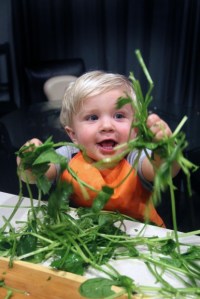
For my flash, I’m bringing you back even closer to home, to a situation with young children that will be familiar to many. Little ones love to help and hate to be helped in almost equal measure. “Let me do it!” and “I can do it myself!” are two frequently heard phrases in households with little ones. Opportunities for both are essential for their developing sense of self, independence and confidence. Both require a great deal of patience on the part of parents and a larger allocation of time than one would normally feel necessary. I think I must have been in a rush and didn’t have time to wait in the queue when patience was being dished out. Fortunately, my children shared some of theirs with me. Sadly, not always soon enough for their benefit. (Sorry, Kids.)
A playdate at Bella’s
Mummy checked the calendar. Oops! Her turn for cake. Dulcie was engrossed playing. Great! Just enough time, if ….
Scarcely was everything out when up popped Dulcie. “Let me do it!”
Too pressed for winnerless battles, Mum kept one eye watching Dulcie, the other on the clock.
With the cake finally baking, Mummy suggested clothes to wear.
“No! I want this one,” pouted Dulcie.
“Let me help with the buttons.”
“No! I can!” objected Dulcie.
Only thirty minutes late, with warm cake and buttons all askew, they arrived.
“Come in,” greeted Bella’s mum, “Looks like you need a hand.”

Thank you for reading. I appreciate your feedback. Please share your thoughts.
Share this:
-
Who teaches whom?

GDJ, Playful stick figures https://openclipart.org/detail/230070/playful-stick-figure-kids The importance of play to a young child’s development and learning is a recurrent theme on my blog. Equally so is the recognition of parents as their child’s first and most important teachers. Alongside this is my acknowledgement of the contribution made by my children to my own learning, especially to my understanding of how children learn.
Although I was often reminded that I had declared, “I’ll teach him,” when a younger brother was born, I had never given a great deal of thought to the teacher-role of siblings. How much that had to do with the reminders of my promise only coming when “naughty” things were occurring, I’m not sure.
Whatever the reason for my lack of consideration, I was quite delighted when I came across the post Siblings are a young child’s most influential teacher by Deborah Stewart on Teach Preschool. In this lovely post Deborah provides a wonderful list of lessons learned from siblings, and supports it with beautiful photographic evidence of her three gorgeous grandchildren.
Included in her list are things like learning to:
- be imaginative
- trust
- be brave
- try new things
- be kind
- laugh, and
- love.
I have a large number of siblings from whom I’m sure I learned many things. As my younger brother could testify, probably not all of them were good. Deborah’s post challenged me to think about what those lessons might have been.
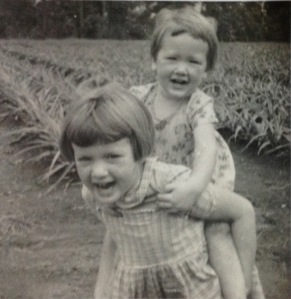
My big sister and me © Norah Colvin Here are some of the (better) ones I thought of, that weren’t on Deborah’s list:
- to share, to take turns, and to wait (unless there’s only a few more cookies or lollies on the plate, then you’d better get in quickly before someone else does!)
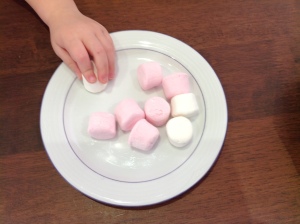
- that you can’t always be first or win, and
- that the world doesn’t revolve around you
- to make our own fun by creating our own games
- to get along with children of all ages
- to play without the constant participation or supervision of adults
- to look out for and look after each other
- to plan together
- to forgive and get on with it
- that a combined effort was more likely to get us an ice cream from the ice cream van than a succession of individual appeals.

http://www.morguefile.com Some of these lessons weren’t easy, and some are still in progress, but important life lessons nevertheless.
What about you? Do you have siblings, or are you an only child? If you have siblings, what have you learned from them?
Thank you for reading. I appreciate your feedback. Please share your thoughts.
Share this:
-
Don’t fence me in
This week at the Carrot Ranch Charli Mills is talking about anxiety, panic attacks and agoraphobia.
The following statements taken from the Mayo Clinic website explain agoraphobia as:
“a type of anxiety disorder in which you fear and often avoid places or situations that might cause you to panic and make you feel trapped, helpless or embarrassed.”
“The anxiety is caused by fear that there’s no easy way to escape or seek help if intense anxiety develops.”
“Most people who have agoraphobia develop it after having one or more panic attacks, causing them to fear another attack and avoid the place where it occurred.”
“Agoraphobia treatment can be challenging because it usually means confronting your fears.”
Sometimes, as Charli says, we can face our fears head on and defeat them with the choices we make. Other times we may need support to help us overcome them. Sometimes therapy and medication may be needed to help those suffering the debilitating effects of anxiety. I will not be discussing those paths in this post. Nor am I going to talk about the anxieties of children with Asperger’s or Autism. There are others who do a much better job of it and are much more knowledgeable than I, such as Sherri Matthews and Shawna Ainslie.

However, it is not uncommon for a child to occasionally feel anxious and stressed by situations that occur at school. The incidence increases when children are placed in situations that are inappropriate to their development and don’t respect their needs. Sometimes the anxiety and stress is manageable and alleviated by more appropriate circumstances outside of the school environment. But sometimes the distress to the child and family can increase to a level at which more help and support is required.
A school environment more suited to children’s needs would reduce the number of anxious and stressed students, parents, and teachers. Creating a nurturing and supportive school environment requires a firm understanding of child development and a belief in their ability to learn. It also requires that children are respected and appreciated for who they are, and that they receive timely and appropriate feedback, encouragement, and support.
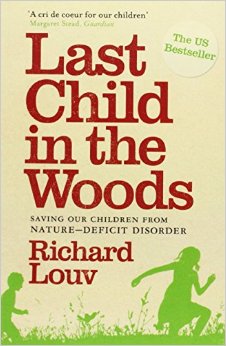
In recent posts I have mentioned the importance of play, and of time spent in, and learning outdoors, in nature. In his book Last Child in the Woods, Richard Louv espouses the importance of nature to the development of healthy children, as well as to the physical health and well-being of adults. Perhaps more time in nature would provide the calm that is needed to combat the hustle and bustle of modern life and pressures of formal, test-driven classrooms.
In fact, it is not just “perhaps”. In his article The School of Nature Louv provides evidence of benefits to learning that nature-based and place-based education can bring. He says, “greening schools may be one of the most cost-effective ways to raise student test scores.”
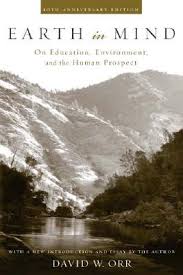
David Orr agrees. In his book Earth in Mind: On Education, Environment and the Human Prospect, he also stresses the importance of learning about, from, and in nature. He says, that, “all education is environmental education. By what is included or excluded we teach students that they are part of or apart from the natural world.”
It is easy to talk about the failings of the school system and suggest ways it could be improved. It is more difficult to make the desired changes happen. While the majority of teachers work hard to create warm, supportive, nurturing environments for children, there are many situations over which they have no control. It is important then to have strategies for dealing with anxiety and stress if they occur.

I recently came across a book that may be useful if your child tends towards anxiety. Stress Can Really Get on Your Nerves aims to provide children with strategies for coping with stress. Written by Trevor Romain and Elizabeth Verdick, it is published by free spirit Publishing as one of a series aimed at helping 8 – 13 year-olds “get through life rough spots”. With Trevor’s fun, cartoon-like illustrations on every page, the book promises to turn stressed out kids into “panic mechanics” with a toolkit of suggestions for reducing their own stress levels. I’d have to say, they’re not bad strategies for anyone’s toolkit.

https://openclipart.org/detail/2921/toolkit I first heard about the book on the free spirit publishing blog in a post by Trevor in which he explains how drawing helped him cope with his learning difference. Trevor may be an outlier, but his story certainly provides inspiration for those who struggle in the traditional classroom.

I think time outdoors, breathing the fresh air, and enjoying the natural world is a great antidote to stress. I may no longer gambol in the grass, but I can sit in stillness and quiet, appreciating the beauty around me as I unplug from technology and reconnect by grounding myself in nature. I’m not sure how that works for agoraphobics with a fear of open places though. Perhaps having more time in nature as a child and learning techniques for coping with anxiety and stress could work as a preventative. But it’s only a thought. I am no expert.
This brings me back to Charli Mills and her flash fiction prompt to In 99 words (no more, no less) write a response to an agoraphobic moment. I have used the Mayo Clinic’s broader interpretation rather than the “narrow” definition of “fear of open spaces”. (I’d rather not be fenced in!) I hope my story portrays a recognisable response that could occur in a variety of circumstances. Please let me know what situation you think of as you read, and whether you consider my attempt successful.
Confrontation
She could hardly manage to chew, let alone swallow, the morsel of cereal occupying her mouth.
Her vacant stare and stifled moans alerted him.
“Are you okay?”
“I’m trying,” she mumbled, and squeezed her hands between her quivering knees.
“You’ll be fine. You haven’t had an attack for months. And, you’re prepared.”
“I know.” She pressed her arms against her gurgling belly. “But …”
He waited.
Finally, she looked at him. “But …”
He sponged her clammy forehead.
She looked away. “What if they don’t like me?”
“They won’t like you. They’ll love you. Come on. I’ll take you.”
What did you think of as you read? I wrote the piece about young teacher about to meet her first class. Did you pick it?
While anxiety about school is more commonly thought of as presenting in children, it is not uncommon for teachers to suffer from school anxiety as well. We accept that teaching is a stressful role, but for some it can also cause anxiety.
I think there are few who are immune from anxiety. We need to be more open in talking about mental health in general. Recognition, acknowledgment and supportive discussion are important factors in helping to overcome the effects of anxiety.
Thank you for reading. I appreciate your feedback. Please share your thoughts.
Share this:
-
Let’s Talk About Purposeful Play
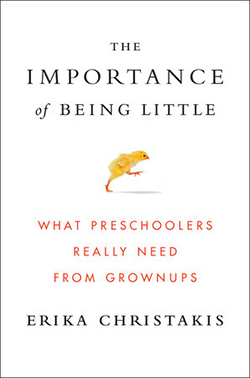
Earlier this week I shared a post and a new book, The Importance of Being Little by Erika Christakis, about the importance of play for young children.
Today I wish to share another post and another new book about the importance of play. This book by Kristi Mraz, Alison Porcelli, and Cheryl Tyler is called Purposeful Play with the tagline Igniting Deep and Joyful Learning Across the Day. (Hint: Click on Kristi’s post here for a chance to win a copy of the book. Read more about the book here to download the first chapter free!)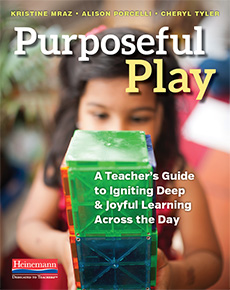
These three teachers begin by stating that all play is purposeful and explain ways of honouring children and their play throughout the day in early childhood classrooms. This book is full of practical ideas for teachers who want to incorporate more play to foster children’s learning and maintain their enthusiasm for and enjoyment of it.
If you wish to make your teaching day more playful, either of these books will provide ideas to get you started.Thank you for reading. I appreciate your feedback. Please share your thoughts.
I am so excited to share that in a week or so my new book (with Alison Porcelli and Cheryl Tyler- play gurus and authors of this handy book on choice time) about PLAY will descend upon this fine earth!!!! Now, listen, there is nothing I like to do more in advance of a new book coming out then have imaginary conversations of excitement and anxiety in my head. As a matter of fact, if you wake up at 3 AM to go to the bathroom, please rest assured that I am staring at my ceiling trying to execute everything I learned while writing A Mindset for Learning.
So, in the hopes of getting the word out about the book, and also maybe stop communing with my ceiling in the wee hours of the morning, I thought it might be nice to put out a post that conquers some of the…
View original post 1,278 more words
Share this:
-
Let them play!
GDJ, Playful stick figures https://openclipart.org/detail/230070/playful-stick-figure-kids Play is essential to learning, and creating an environment which allows for play while nurturing children’s learning and development is as important as creating an environment that nourishes and encourages the growth of plants in a garden. The link between the two was first recognised by Froebel in the early 19th century when he coined the term “kindergarten” which translates to “garden for children” (kinder meaning child and garten meaning garden), and created the first educational toys.
Froebel “devoted his life to educating children and developing methods to maximize human potential”. He was the first to recognise the importance of a child’s early years (birth to three) and considered creativity to be something in all of us.
Froebel’s kindergartens were the first “formal” education for young children and his work greatly influenced that of other educators such as Maria Montessori and Rudolf Steiner. His beliefs, for example that children have both unique needs and capabilities are still influential today. He believed in the importance of play and some of his toys were favourites of people such as Buckminster Fuller and Albert Einstein.
I have touched on the topics of play, creativity and children’s uniqueness in previous posts. A respectful, encouraging, nurturing and stimulating environment underpins all that I value in education; as does a belief in the power of play to develop understandings of self, of others and relationships, of the world and how things work, and to inspire thoughts of what could be, to imagine possibilities never before imagined.
While Froebel’s beliefs, and those of his followers, are still valid, sadly they are often disregarded by those who wield the power in education, who dictate otherwise.
In a previous post I shared an article by Paul Thomas who attributed his readiness to learn at school to the richness of his home environment. He also decried the formal tedium of school lessons which contribute much to curbing a child’s enthusiasm for learning. Paul is not alone in his views. There are many teachers who agree with him, myself included, as I have shared many times before, including here and here.
I am not the only early childhood teacher to be saddened and appalled by the formal approach that has been enforced upon teachers, replacing play-based approaches in classrooms for children as young as four. With the administration of standardised tests and the publication of graded results, children are labelled successes or failures before they have had a chance to develop. Those children from privileged backgrounds, as described by Thomas in Formal Schooling and the Death of Literacy will be immediately successful. Those from less advantaged backgrounds will be labelled failures. Unfortunately, the labels are often reinforced with little chance of replacement.

I am always gladdened when I hear another expounding the benefits of play and the importance of child-centred approaches to learning and teaching. I hope that when enough voices unite in this important message, the tide will start to turn, and those with the power to make changes will do so in favour of children.
This week I read another article stressing the importance of play for young children. The article, written by Susan Gonzalez for Yale News, introduces a recently published book by Erika Christakis The Importance of Being Little. I have not yet read the book, but I know that I will agree wholeheartedly with its content. The title itself tells me the value of its message.
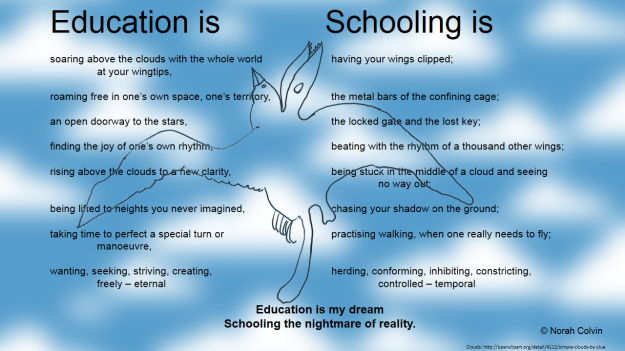
© Norah Colvin In words reminiscent of my poem “Education is” Christakis says that “schooling and learning are often two different things.” Here is just a sprinkling of her thoughts reported in the article.
- children are capable and powerful but our expectations are often mismatched
- we ask too much of children pragmatically but not enough cognitively
- there is too much teacher-direction and not enough time for play in many preschool classrooms
- teachers need to take the time to listen to children’s stories, to laugh with them, to get down on the floor, at their eye level, and figure out what makes them tick … (through) … respectful observation
- childhood pedagogy should be based on ideas, not on the repetition of simple skills
- respect for early childhood as a life stage worthy in its own right and not merely as a training ground for an adult future
These are ideas I have oft repeated here on my blog. Please read the article in full and, if you are as inspired as I am, read the recently published book The Importance of Being Little. I’d love to know what you think.

Thank you for reading. I appreciate your feedback. Please share your thoughts.
Share this:
-
Formal Schooling and the Death of Literacy
Paul Thomas in this post describes the literate home environment of his early childhood days, an environment that created his advantage, his privilege in becoming literate.
He also describes the tedium of school days that had to be endured rather than enjoyed, and decries the cult of measuring and labeling texts and students that “murders literacy among our students“.
He goes on to say that “The very best and most effective literacy instruction requires no textbooks, no programs, and no punitive reading policies.
Literacy is an ever-evolving human facility; it grows from reading, being read to, and writing—all by choice, with passion, and in the presence of others more dexterous than you are.”
I couldn’t agree more.
If you enjoy this post by Paul, check out this follow-up post Everyone Learns to Read by Direct Instruction on his blog the becoming radical. You may find many other posts of interest as well.Thank you for reading. I appreciate your feedback. Please share your thoughts.
My privilege is easily identified in my being white and male, but it is the story of my life that better reveals my enormous privilege established by my mother when I was a child.
I entered formal schooling with such a relatively high level of literacy and numeracy that from those first days I was labeled “smart”—a misnomer for that privilege.
From Green Eggs and Ham to Hop on Pop, from canasta to spades, from Chinese checkers to Scrabble—games with my mother and often my father were my schooling until I entered first grade. And none of that ever seemed to be a chore, and none of that involved worksheets, reading levels, or tests.
Formal schooling was always easy for me because of those roots, but formal schooling was also often tedious and so much that had to be tolerated to do the things I truly enjoyed—such as collecting, reading…
View original post 1,019 more words
Share this:
-
Adventures in Learning

http://www.morguefile.com I have never been physically adventurous; never dived off a high cliff, surfed a rolling wave or bungeed into an abyss; I don’t like heights and get no thrill from the thought of a roller-coaster ride. I don’t believe it’s fear that holds me back. It’s lack of interest and opportunity: I never sought it and it never sought me.
When I was very little I earned the nickname “Possum” because, apparently, I was a climber and constantly getting into mischief. I soon had that knocked out of me by a combination of physical and verbal admonitions. Perhaps this contributed to my dislike of heights, but I think my disinclination for the adrenalin rush of physical activities was inborn.

http://www.morguefile.com Fear probably does contribute to my reluctance to participate in other height related activities such as parasailing, hang gliding, gliding and hot air ballooning. Each of these does have a certain amount of appeal and I think I would love the experience, if I was brave enough to take the leap. One day perhaps.
Not only were my explorations through climbing curtailed, I was also discouraged from conducting my own investigations and from asking questions. While my parents encouraged reading through library membership and giving books as gifts, my father was often heard to say, “What you don’t know won’t do you any harm.” Though I read avidly, self-selected material was almost exclusively fiction. Non-fiction was the realm of textbooks set for study in boring school subjects with enforced memorisation for regurgitation in exams and then promptly forgotten.
http://www.openclipart.com Fortunately, I gained some sense of the limitations of my own experiences and thinking and endeavoured to avoid limiting my own children in similar ways. Only they will be able to say how much their experiences and learning were restricted. Neither is into extreme physical challenges and I certainly didn’t provide them with opportunities that may have encouraged such activities. However, I did encourage them to be curious, to ask questions and to investigate. I closed the door on thinking that revered ignorance and opened the one for adventures into learning.
It is important for parents and teachers to realise the impact of their attitudes, expressed and otherwise, on the developing attitudes of their children. There is a lovely poem Children Learn What They Live by Dorothy Law Nolte that expresses it rather well.
Below is a list of a few further ingredients that I consider essential for maintaining the fun and adventure in learning throughout life. I’m sure you will think of many more.
Children learn best when they have time to:
- play,
- choose,
- grow and develop,
- think,
- problem solve,
- make many attempts,
- develop independence,
- create,
- be,
- question,
- wonder,
- imagine,
- explore, and
- discover
in an environment of respect and encouragement that is unhurried and non-competitive.
While I often say that children are born scientists, constantly exploring the world and conducting experiments to find out what works, we can sometimes take their discoveries for granted as their investigations confirm for them something it seems that we have always known; for example, that something dropped will fall. However, any question that a child asks can be a springboard into further learning. It is the questions asked that have driven science discoveries and understandings: questioning, wondering and imagining.
It is these adventures into the unknown, the exhilaration of learning, that drive me and that have inspired my response to the flash fiction challenge by Charli Mills at the Carrot Ranch to In 99 words (no more, no less) write an adventure, experienced or witnessed. I hope you enjoy it.
As she reached for the unicorn-shaped balloon the man smiled and winked. She hesitated, accepted the balloon, and pushed back through the small audience. Something made her turn. The bystanders, the man, and the balloons were gone. Puzzled, she scanned the crowd for her mum. A sudden gust puffed out her skirt and, as she clutched the unicorn, lifted her high and away: across the city, over the fields, beyond the horizon; and back. She gazed at the patchwork unfolding: beautiful, connected, serene; and recognised herself a part. As she descended all was as before. Only she had changed.
And if you are wondering about a unicorn-shaped balloon, it is possible:
Thank you for reading. I appreciate your feedback. Please share your thoughts.
Share this:
-
Thankful and inspired: schools and education
I have just watched the movie “He named me Malala”. The message has not lost its importance or impact. Sadly the need for her message to be heard and responded to has only grown over time. I share this post again as a reminder of Malala’s courage, strength, and determination. She says, “The terrorists thought they would change my aims and stop my ambitions, but nothing changed in my life except this: weakness, fear and hopelessness died. Strength, power and courage were born.”
In recent posts there was some discussion about the importance of education, the value of schools and the role of teachers. I thought it timely to re-share this post, first published in July 2015.
Earlier this week I read a post by Kimmie of Stuck In Scared about Ten Things of Thankful. I have also read many other posts about things to be thankful for. These posts prompted me to share something for which I am thankful: schools and education.
I know that I often write about what I consider the shortcomings of traditional schooling and make suggestions of how schools could be improved. However I live in a country that values education and in which every child has a right to a free education. For that I am thankful. Those of us who have access to schools and education are the lucky ones.
This week I have been…
View original post 238 more words
Share this:
-
Starting with one

© Charli Mills There’s an event worth celebrating at the Carrot Ranch this week. Two years after posting her first prompt encouraging writers to hone their writing skills by joining the 99-word flash fiction posse, Charli Mills has posted her 99th.
I’m proud to say that I’ve been there since the first, riding the range of story prompts with others who have gathered around the campfire to share stories, wise words and writing tips in response to the nurturing offered by Charli’s warm, honest and generous spirit. It is she who is the hub around which has formed a community that is welcoming, supportive and encouraging. She is the one who keeps the wheels turning, the imaginations stirring and the words flowing.
© Charli Mills It is fitting, therefore, that her 99th challenge is to in 99 words (no more, no less) write about the idea of “just one.” If all it takes is just one, what is the story? Explore what comes to mind and go where the prompt takes you. Bonus challenge: eat cake while you write, or include cake in your flash. She is the “just one” who, week after week, writes an inspiring post, sets a thought-provoking challenge, ropes in the writers and compiles the stories into a collection as diverse as the readers. It would be interesting to know how many writers have answered every prompt. I don’t think the number would be large as even I didn’t manage to ride every muster.
I take this opportunity to congratulate Charli on her initiative. In this recent post she restates that “the original intent of Carrot Ranch as of March 5, 2014 was to create a bully-free zone where writers could learn to access creativity through problem solving (the constraint); write from a unique perspective (diversity); read and discuss the process or prompt (engagement).” There is no question that she has achieved that and more. I have met many wonderful writers, bloggers and friends through my visits to the Carrot Ranch. If you are not yet a visitor, I suggest you pop on over. You’ll be warmly welcomed.

Recently I received as a gift a book called “One: How many people does it take to make a difference?” The book is filled with many wonderful quotes, stories and suggestions; too many to share, in one post anyway. I decided to open the book to a random page and share what I found. This is it:
“If someone listens, or stretches out a hand, or whispers a kind word of encouragement, or attempts to understand, extraordinary things begin to happen.” Loretta Gizartis

That’s a pretty powerful quote. The effects of Charli’s “just one” contributions are easy to see. The quote is equally applicable to teachers and the effects that they may have upon the lives of others.

It is lovely when teachers are publicly (or privately) acknowledged for the positive influence they have had upon a life. Charli did this recently when she acknowledged a high school teacher who had encouraged her to achieve more than she thought she could.

Last month when announcing the Top Ten Finalists for the Global Teacher Prize Stephen Hawking acknowledged one who had had a powerful effect upon his life. He said,
“Thanks to Mr Tahta, I became a professor of Mathematics at Cambridge, in a position once held by Issac Newton. I have spent my life attempting to unlock the mysteries of the universe. When each of us thinks about what we can do in life, chances are we can do it because of a teacher.”
Even teachers need mentors and many can name one who has made a difference to their lives. As if in response to Charli’s challenge, this week Vicki Davis, the Cool Cat Teacher, nominated “just one” personal mentor who had taught her the most about teaching. Of Maryfriend Carter, Vicki says,
“I’m grateful for her mentorship and encouragement in my life. She changed my thinking about teaching as she taught me about teaching. She single-handedly convinced me that testing doesn’t work and what does.”
But not all who teach the most important lessons in life are “professional” teachers. There is a great saying that goes something like, “When the student is ready the teacher appears.” I often say that my own children have been my best teachers. But I have also been inspired by other wonderful teachers too. I have mentioned many of them in previous posts including here, here and here.
However, my response to Charli’s flash fiction challenge aims to demonstrate that even the smallest, seemingly inconsequential, action can have a powerful effect upon the life of another. Sometimes we learn of the effects, sometimes we don’t; but when we do, the effect can be magnified. I hope it works.
The Power of One
Only much later, through a chance meeting with mutual friends, did she discover her power of one.
“I know you,” said the other, pointing her cake fork. “You’re the one.”
The old fear gripped, twisting tight. Her cake lost its appeal.
“Which one?” another asked.
“In the foyer. On the first day. You spoke to me.”
“Oh,” she reddened, shrinking to nothingness inside.
“I was so nervous. You made me feel welcome, at ease. I’ve been wanting to thank you.”
“Oh,” she lifted her fork, smiling. “You’re welcome.”
“If only you knew,” she thought. “I did it for me.”
Thank you for reading. I appreciate your feedback. Please share your thoughts.
Share this:


 Norah Colvin