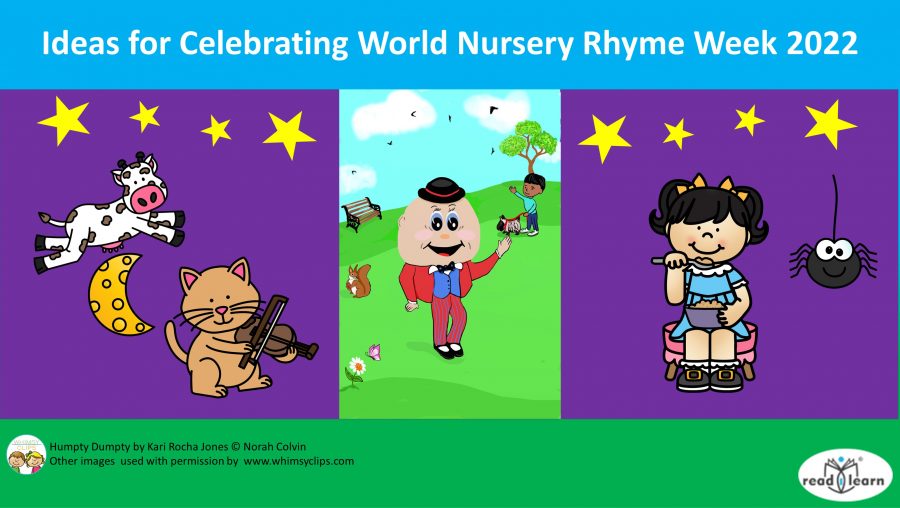
Next week, from 14th – 18th November, is World Nursery Rhyme Week. Why not celebrate by revisiting some of the children’s (and your) favourite nursey rhymes. Children in our F – 2 classrooms can explore language features and use them as a springboard for writing, recitation, and role play. Children in older classrooms may like to investigate their (often dark) origins and history.
The aim of World Nursery Rhyme Week is to promote the importance of nursery rhymes in early education. The five official nursery rhymes for this year’s celebration are:
The Big Ship Sails
1, 2, 3, 4, 5 Once I Caught a Fish Alive
Five Little Speckled Frogs
B.I.N.G.O.
Twinkle, Twinkle Little Star.
However, you are welcome to use any nursery rhymes you like, and here at readilearn we have some resources to assist your teaching.
readilearn nursery rhyme resources
Humpty Dumpty
Teach literacy skills and develop creative thinking and imagination with Humpty Dumpty.
The Humpty Dumpty suite of resources includes:
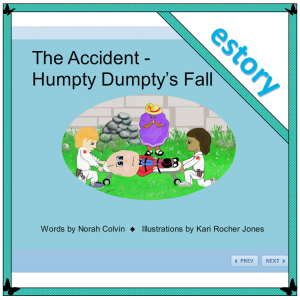
The Accident — Humpty Dumpty’s Fall is an original story that innovates on the nursery rhyme by providing a scenario that might lead to Humpty’s falling from the wall. It is a digital estory which can be displayed and read on the interactive whiteboard. It can be read as a story on its own or as part of the writing unit Humpty Dumpty — a story in five sittings. (Note: if you wish to implement the writing unit, do so before reading the story.)
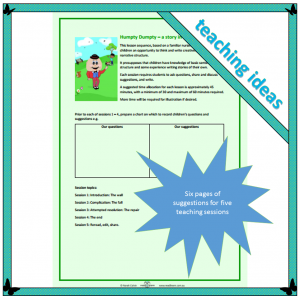
Humpty Dumpty — a story in five sittings is a series of five lessons in writing based upon the nursery rhyme. Each lesson provides opportunities for children to think creatively and imaginatively and to write using a basic narrative structure. It presupposes children already have an idea of sentence structure and some experience writing stories of their own.
Of course, before attempting to read or write an alternative, it is important that children are familiar with the nursery rhyme. We have that covered too, with a printable copy of the nursery rhyme Humpty Dumpty to download.
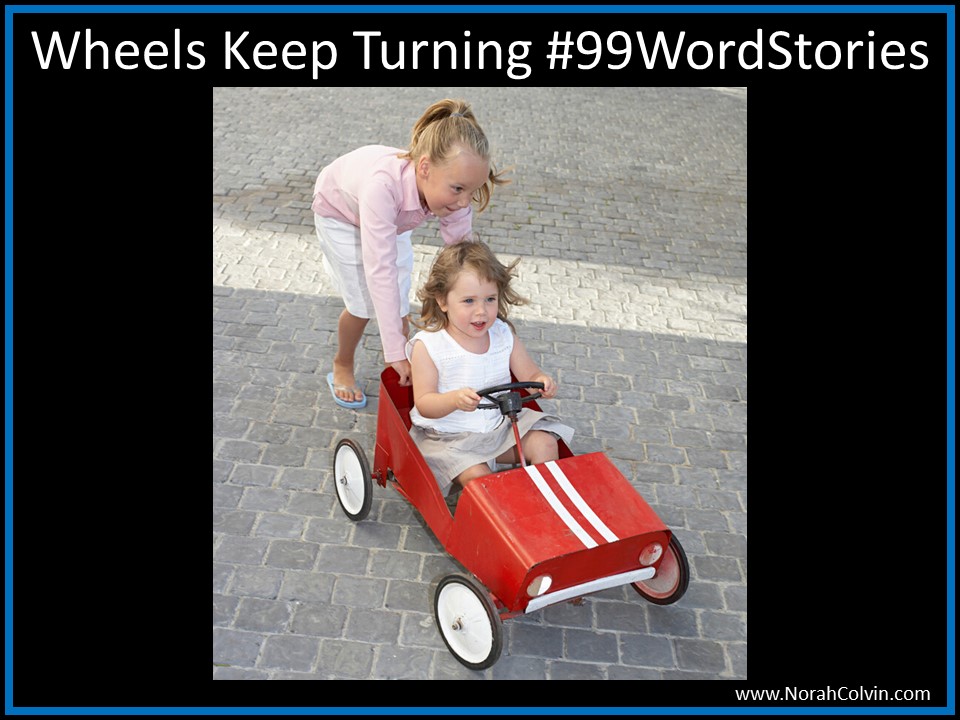
I didn’t have time to write a story in time to be included in the collection, but I wanted to write one anyway. I’ve stayed with Lucy and Amy and their little red convertible as they play with their toys. I hope you enjoy it.
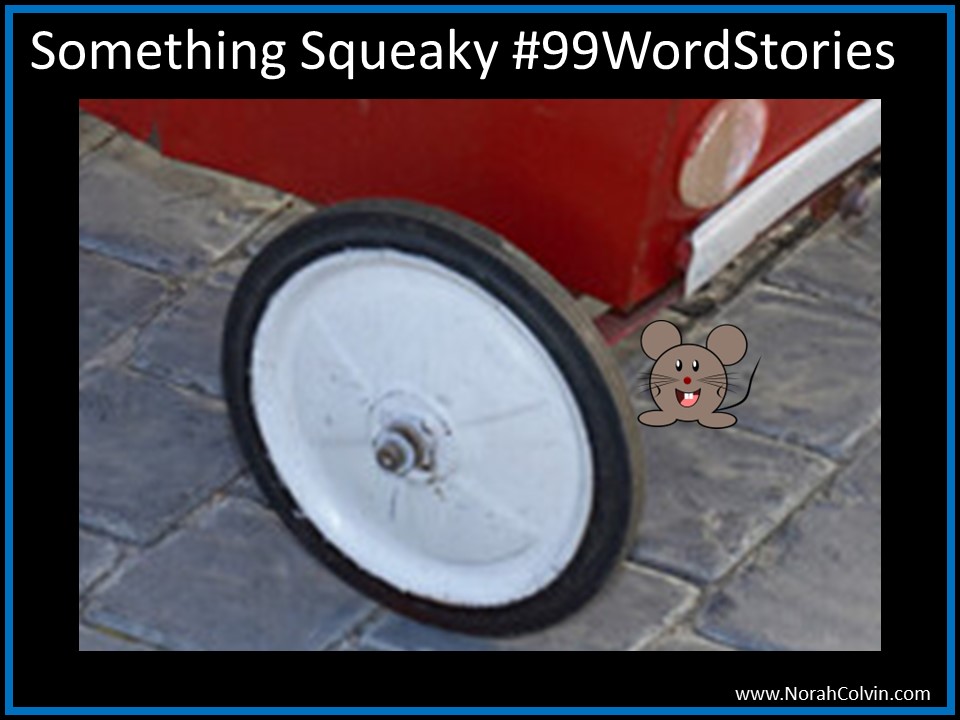
The Squeaky Wheel
“Shh! What’s that noise,” said Lucy.
Amy stopped the car. Everyone was quiet.
“I don’t hear anything,” said Amy.
The others agreed. Nothing.
They continued on their way.
“There it is again,” said Lucy.
Amy didn’t stop the car, but they all listened.
“I hear it,” said Monkey. “Squeak. Squeak. Squeak.”
“Eek!” screamed Ellie. “There’s a mouse in the car!”
“No, silly,” said Bunny. “It’s a squeaky wheel.”
“Just needs some grease,” said Amy. “Everybody out!”
They all piled out. Amy hoisted the little red convertible for Lucy to grease the wheel, then they were on their way again.
Thank you for reading. I appreciate your comments. Please share your thoughts.
Note: The collection of stories made in response to the previous prompt Wheels Keep on Turning, including mine, can be read at the Carrot Ranch.
My first thoughts went to the Rawhide theme song with its ‘Rollin’ rollin’ rollin’’ refrain.
Of course, they’re not wheels that are rollin’, so that song wouldn’t do. But how wonderful to see these actors, who looked so old when I was a child, look not much more than children to me now.
My next thought was of Proud Mary and her big wheel that kept turning.
But that wouldn’t do either.
I wanted to return to my girls Amy and Lucy and their little red convertible from previous stories but couldn’t decide how. You could say the wheels were turning but I wasn’t getting anywhere. Fortunately, I thought of a third song about wheels.
That was more my style and this is my story. I hope you enjoy it.
The Wheels of the Limo
“The wheels of the bus go —. No, wait. The wheels of the limo go round and round, round and round —”
“Why’d ya stop?”
“I didn’t stop. We’re stuck.”
“But the wheels are turning.”
“Must be something underneath. Okay. Everybody out.”
Teddy, Ollie, Ellie, Monkey and Bunny piled out. They watched as Amy hoisted the little red convertible for Lucy to check underneath.
“There’s a rock,” said Lucy. She reached under, withdrew the culprit, and hurled it into the shrubs.
“All aboard!” she called.
The passengers settled back in, and everyone sang, “The wheels of the limo …”
Thank you for reading. I appreciate your feedback. Please share your thoughts.
Note: The collection of stories made in response to the previous prompt Bones, including mine, can be read at the Carrot Ranch.
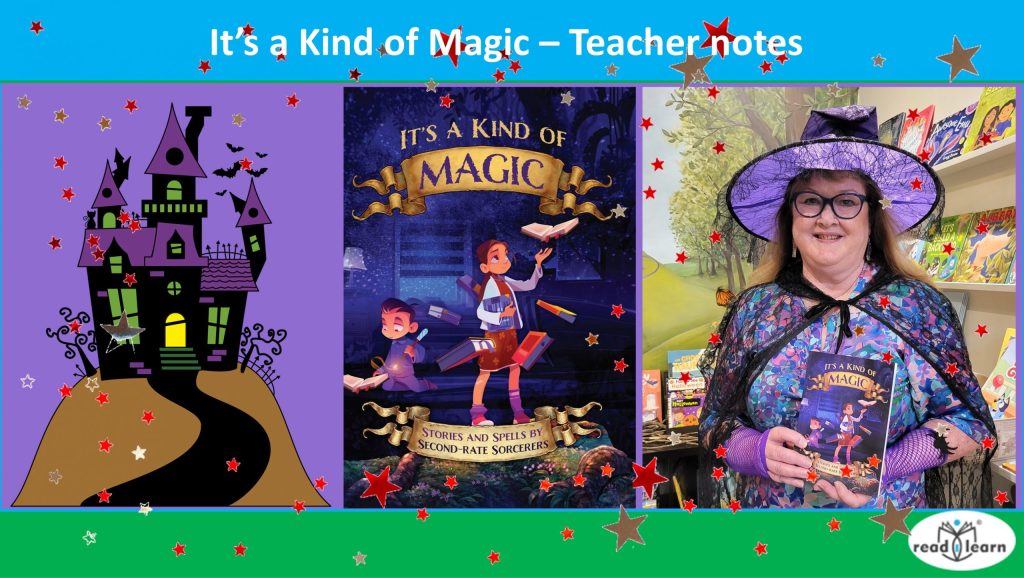
I’m delighted to tell you that It’s a Kind of Magic, Stories and Spells by Second-Rate Sorcerers is now available for purchase. The anthology is a collection of over 35 stories and poems written by authors young and old, emerging and established.
The book launch last Saturday was a lot of fun with story and poetry readings from the book. Authors, poets, children and their parents came in costume to set the mood for the festivities.
After listening to the readings, children did craft activities before trick-or-treating around the shopping centre where they received treats from all the stores whose participation had been organised by the launch host, The Mad Hatters Bookshop. What amazing collaboration to make the day so special for all involved.
It was a great morning and I thank The Mad Hatters Bookshop, Michelle Worthington (publisher and editor of the book and international award-winning author) and Kayt Duncan (author and story teller extraordinaire) for their hard work in making the event such a success. What an amazing team.
It’s a Kind of Magic, Stories and Spells by Second-Rate Sorcerers is available from Amazon and the Book Depository. You might even find it in a local bookstore, like The Mad Hatters Bookshop where the launch was held on Saturday. Proceeds from sales of the book support the charity Children’s Rights Queensland.
If you missed the launch, many of the stories may be viewed on the Storytime with Anthology Angels YouTube channel. If you wish to find out additional information about the writers, many of them have their own websites and are active on social media.
I have written some teacher notes for the book, which I hope you will find useful. You can read them here or download a free PDF copy here.
It is easy to find opportunities for using the book when teaching the English Curriculum as reading aloud by the teacher and opportunities for children to read independently are an essential part of each school day. The stories and poems are short and can be incorporated in the program or turned to when a diversion is needed to settle the class or when there a few minutes wait-time between lessons and activities.
I’ve listed the stories and poems under the following headings so that you can easily find a story or poem that features particular characters, settings, events, themes or language features you are teaching.
Poems and Rhyming Stories
Annie the Wonder Witch by Deborah Huff-Horwood, page 68
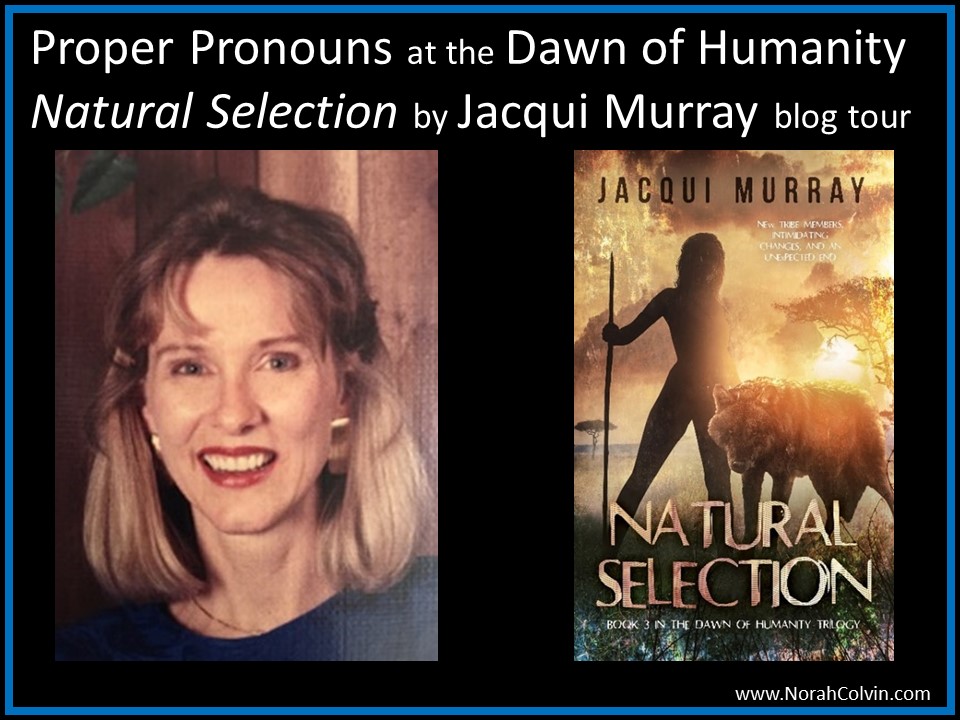
Today it is my pleasure to introduce Jacqui Murray to the blog. Jacqui is a prolific writer and blogger and shares my passion for education. While my focus is the early years, Jacqui’s is tech. She’s my tech education guru.
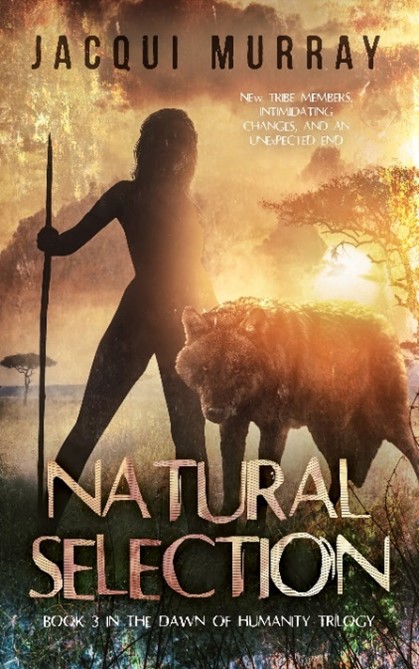
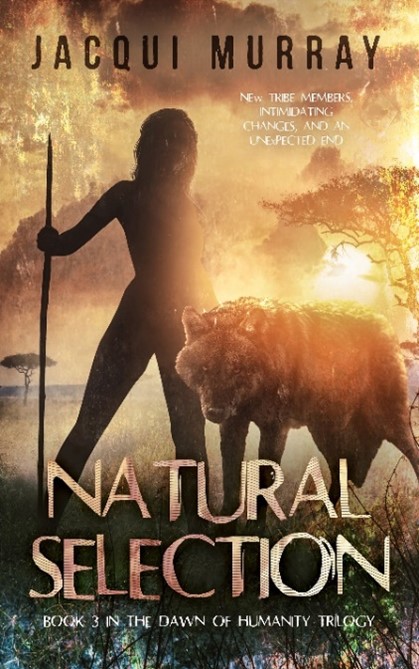
Jacqui’s latest and eagerly awaited book, Natural Selection, is the third in the Dawn of Humanity trilogy. Having read others of Jacqui’s books in her prehistoric fiction saga, I was delighted to support the launch of this one, especially when she agreed to write a post with a connection to education, and even more so when it was as fascinating as this one. I hope you enjoy!
Over to Jacqui.
Why Early Man Didn’t Use Proper Nouns
When you read Natural Selection, you’ll notice quickly none of our earliest ancestors used proper nouns. Even their names come from sounds associated with them, not a relative or symbolic of something about the individual (like ‘Hope’). That’s because earliest man didn’t develop the capacity for symbolism until much later. That meant proper nouns–names–like “Lake Victoria” or “Mount Ngorongoro” (locations in East Africa where these early tribes lived) were meaningless labels. Instead, landmarks were identified by long hyphenated descriptions of where they are, what they look like, and how to find them. For example, the name of a tree that’s just fruited might be “leafy-tree-by boulder-bed-near-waterhole-by-Sun’s-sleeping-nest”.
More later on how early man remembered these long labels!
Consider this reasoning: A town near me is Mission Viejo. The name means nothing to those who haven’t visited. If I went in search of it, it wouldn’t be near a green mission. I’d have to find it on a map program. Early man didn’t have this so the label applied by those in the area would instead be directions on how to find it—“at-the-end-of-wide-animal-path”. Same with lakes, waterholes, fruit trees, hills, herds, or anything else in the area. You and I would have trouble remembering the long names, but primitive tribes had prodigious memories and easily remembered lots of details. By providing such a thorough description, any tribe member could find the location even if they had never been there by simply following the designations provided.
This shocked early explorers, both that people considered dumb primitives had such good memories and that they could travel long distances without maps or compasses. The famous anthropologist Margaret Meade had the same epiphany when she lived with primitive tribes for extended periods of time to study them. Symbolic proper nouns were meaningless. In fact, they were confusing.
To put this in perspective: If you are hiking in the mountains or through the wilderness you have never visited before and want to guide someone to where you are, the proper noun name you made up (“Porter’s Creek”) does no good. Telling them to follow the waterway that cuts between the two hills and aims to the sun is much more helpful.
About Jacqui Murray
Jacqui Murray is the author of the popular prehistoric fiction saga, Man vs. Nature which explores seminal events in man’s evolution one trilogy at a time. She is also author of the Rowe-Delamagente thrillers and Building a Midshipman, the story of her daughter’s journey from high school to United States Naval Academy. Her non-fiction includes over a hundred books on integrating tech into education, reviews as an Amazon Vine Voice, a columnist for NEA Today, and a freelance journalist on tech ed topics.
About Natural Selection
In this conclusion to Lucy’s journey, she and her tribe leave their good home to rescue former-tribe members captured by the enemy. Lucy’s tribe includes a mix of species–a Canis, a Homotherium, and different iterations of early man. In this book, more join and some die, but that is the nature of prehistoric life, where survival depends on a combination of our developing intellect and our inexhaustible will to live. Each species brings unique skills to this task. Based on true events.
Set 1.8 million years ago in Africa, Lucy and her tribe struggle against the harsh reality of a world ruled by nature, where predators stalk them and a violent new species of man threatens to destroy their world. Only by changing can they prevail. If you ever wondered how earliest man survived but couldn’t get through the academic discussions, this book is for you. Prepare to see this violent and beautiful world in a way you never imagined.
A perfect book for fans of Jean Auel and the Gears!
Book trailer
Jacqui has generously shared the first chapter of Natural Selection to tantalize your tastebuds for prehistoric fiction. Thank you, Jacqui.
The Canis’ packmates were all dead, each crumpled in a smeared puddle of blood, Upright killing sticks embedded where they should never be. His body shook, but he remembered his training. The killers’ scent filled the air. If they saw him—heard him—they would come for him, too, and he must survive. He was the last of his pack.
He padded quietly through the bodies, paused at his mate, broken, eyes open, tongue out, pup under her chest, his head crushed. A moan slipped from his muzzle and spread around him. He swallowed what remained in his mouth. Without a pack, silence was his only protection. He knew to be quiet, but today, now, failed.
To his horror, a departing Upright looked back, face covered in Canis blood, meaty shreds dripping from his mouth, the body of a dead pup slung over his shoulder. The Canis sank into the brittle grass and froze. The Upright scanned the massacre, saw the Canis’ lifeless body, thought him dead like the rest of the decimated pack. Satisfied, he turned away and rushed after his departing tribe. The Canis waited until the Upright was out of sight before cautiously rising and backing away from the onslaught, eyes on the vanished predators in case they changed their minds.
And fell.
He had planned to descend into the gully behind him. Sun’s shadows were already covering it in darkness which would hide him for the night, but he had gauged his position wrong. Suddenly, earth disappeared beneath his huge paws. He tried to scrabble to solid ground, but his weight and size worked against him and he tumbled down the steep slope. The loose gravel made gripping impossible, but he dug his claws in anyway, whining once when his shoulder slammed into a rock, and again when his head bounced off a tree stump. Pain tore through his ear as flesh ripped, dangling in shreds as it slapped the ground. He kept his legs as close as possible to his body and head tucked, thankful this hill ended in a flat field, not a river.
Or a cliff.
When it finally leveled out, he scrambled to his paws, managed to ignore the white-hot spikes shrieking through his head as he spread his legs wide. Blood wafted across his muzzle. He didn’t realize it was his until the tart globs dripped down his face and plopped to the ground beneath his quaking chest. The injured animal odor, raw flesh and fresh blood, drew predators. In a pack, his mate would purge it by licking the wound. She would pronounce him Ragged-ear, the survivor.
Ragged-ear is a strong name. A good one.
He panted, tail sweeping side to side, and his indomitable spirit re-emerged.
Except, maybe, the female called White-streak. She often traveled alone, even when told not to. If she was away during the raid, she may have escaped. He would find her. Together, they would start over.
Ragged-ear shook, dislodging the grit and twigs from his now-grungy fur. That done, he sniffed out White-streak’s odor, discovered she had also descended here. His injuries forced him to limp and blood dripping from his tattered ear obstructed his sight. He stumbled trying to leap over a crack and fell into the fissure. Fire shot through his shoulder, exploded up his neck and down his chest. Normally, that jump was easy. He clambered up its crumbling far wall, breaking several of his yellowed claws.
All of that he ignored because it didn’t matter to his goal.
Daylight came and went as he followed White-streak, out of a forest onto dry savannah that was nothing like his homeland.
Why did she go here?
He embraced the tenderness that pulsed throughout his usually-limber body. It kept him angry and that made him vicious. He picked his way across streams stepping carefully on smooth stones, their damp surfaces slippery from the recent heavy rain, ignoring whoever hammered with a sharp rock inside his head. His thinking was fuzzy, but he didn’t slow. Survival was more important than comfort, or rest.
Ragged-ear stopped abruptly, nose up, sniffing. What had alerted him? Chest pounding, breathing shallow, he studied the forest that blocked his path, seeking anything that shouldn’t be there.
But the throbbing in his head made him miss Megantereon.
Ragged-ear padded forward, slowly, toward the first tree, leaving only the lightest of trails, the voice of Mother in his head.
Yes, your fur color matches the dry stalks, but the grass sways when you move. That gives away your location so always pay attention.
His hackles stiffened and he snarled, out of instinct, not because he saw Megantereon. Its shadowy hiding place was too dark for Ragged-ear’s still-fuzzy thinking. The She-cat should have waited for Ragged-ear to come closer, but she was hungry, or eager, or some other reason, and sprang. Her distance gave the Canis time to back pedal, protecting his soft underbelly from her attack. Ragged-ear was expert at escaping, but his stomach spasmed and he lurched to a stop with a yowl of pain. Megantereon’s next leap would land her on Ragged-ear, but to the Canis’ surprise, the She-cat staggered to a stop, and then howled.
While she had been stalking Ragged-ear, a giant Snake had been stalking her. When she prepared her death leap, Snake dropped to her back and began to wrap itself around her chest. With massive coils the size of Megantereon’s leg, trying to squirm away did no good.
Ragged-ear tried to run, but his legs buckled. Megantereon didn’t care because she now fought a rival that always won. The She-cat’s wails grew softer and then silent. Ragged-ear tasted her death as he dragged himself into a hole at the base of an old tree, as far as possible from scavengers who would be drawn to the feast.
He awoke with Sun’s light, tried to stand, but his legs again folded. Ragged-ear remained in the hole, eyes closed, curled around himself to protect his vulnerable stomach, his tail tickling his nose, comforting.
He survived the Upright’s assault because they deemed him dead. He would not allow them to be right.
Sun came and went. Ragged-ear consumed anything he could find, even eggs, offal, and long-dead carcasses his pack normally avoided. His legs improved until he could chase rats, fat round ground birds, and moles, a welcome addition to his diet. Sometimes, he vomited what he ate and swallowed it again. The day came he once again set out after what remained of his pack, his pace more sluggish than prior to the attack, but quick enough for safety.
Ragged-ear picked up the female’s scent again and tracked her to another den. He slept there for the night and repeated his hunt the next day and the next. When he couldn’t find her trace, instinct drove him and memories of the dying howls of his pack, from the adults who trusted their Alpha Ragged-ear to protect them to the whelps who didn’t understand the presence of evil in their bright world.
Everywhere he traveled, when he crossed paths with an Upright, it was their final battle.
Find out more about Jacqui or connect with her on Social Media
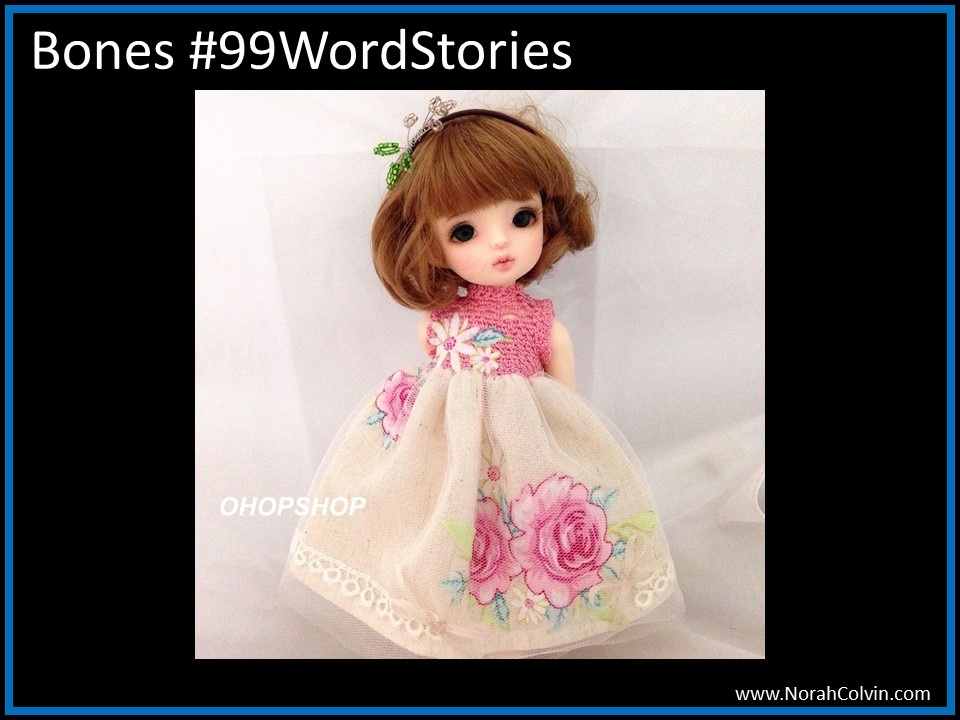
All I could think of at first was the children’s song, ‘The head bone’s connected to the neck bone …’ and it took me a while to come up with an idea. Once I got an idea, the ending eluded me. I finally decided to go all-out horror, which is unusual for me, to follow up my entry Beware or Be Scared in the Halloweensie Contest run by Susanna Leonard Hill. That entry was meant to be as Halloween humorous as it was scary. I hope it succeeded. On its own, this one may lack the humour. I hope you ‘enjoy’ it anyway.
Make No Bones About It
“Go and get changed.”
“But, Muuuum —”
“You will not go to the party dressed like that.”
“Why?”
“It’s not appropriate.”
“But it’s dress up. It’s Halloween!”
“Yes! A skeleton or a ghost. Not a princess. Princesses don’t do Halloween.”
“If I can’t be a princess, I’m not —” The door slammed to punctuate her sentence perfectly.
Mum shook her head. She was teased enough, without being a princess on Halloween.
The following morning, when bones found in the middle of a mystery sticky stinky sludge were identified as her bullies, Margie and Mum gave thanks for their disagreement.
Thank you for reading. I appreciate your feedback. Please share your thoughts.
Susanna Leonard Hill is hosting the 12th Halloweensie Contest and entries close on Monday 31 October. You may still have time to enter. All you have to do is write a 100-word Halloween-themed story for children up to 12 and include the words slither, treat and scare. Easy right? Pop over to Susanna’s amazing blog for all the rules, and join in if you dare. There are some pretty amazing prizes.
You will be able to read all the entries in the comments section of the Official Contest Post after the weekend. By next weekend, Susanna hopes to have narrowed the field down to about twelve stories for readers to vote on. What a mammoth task.
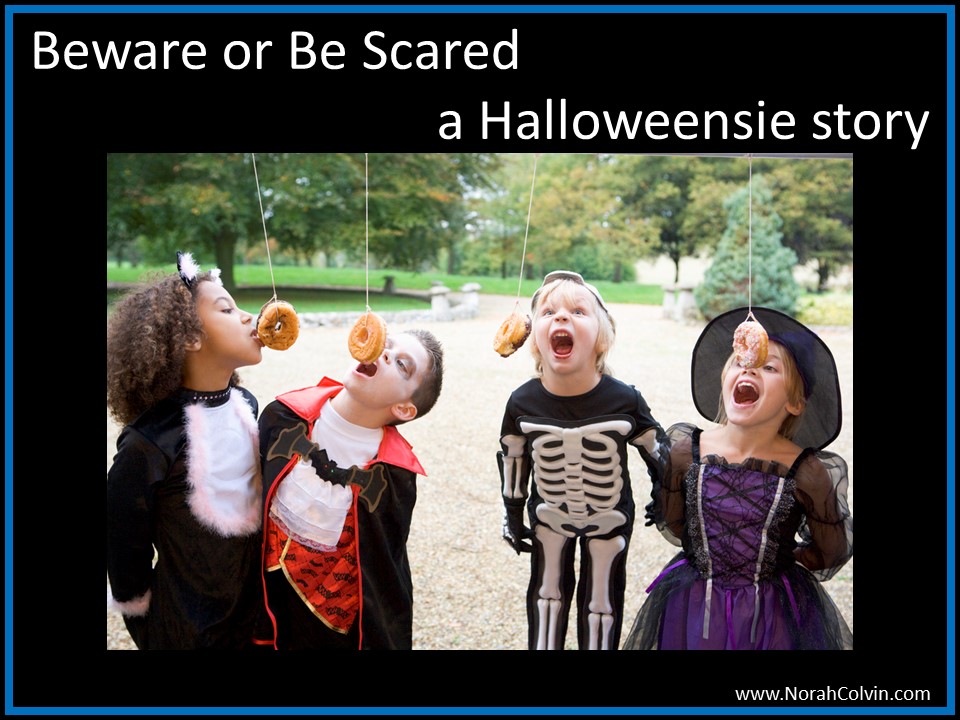
Since I’ve been practising writing brief stories in the Carrot Ranch flash fiction challenges, I thought I’d have a go at this one too and, I guess not surprisingly, I’ve done it in 99 words (you’re allowed to go under, but not over, 100 words). While my flash fiction stories often feature children, this one had to be for children. I hope I didn’t make it too scary, but I aimed it at the older, rather than younger, age group, who I hope may ‘get’ some of the nuances with word choice and punctuation. I hope you enjoy it. You are forewarned.
Nathara expected her ginormous jelly Poisonous Pythons, individually sealed for hygiene safety, to make the children’s eyes POP! And they did. Laced, through the fence the treats were irresistible. Children ignored the “BEWARE” sign. They failed to read the small print “Open only after midnight.” They didn’t flinch when Nathara laughed, “Mwahahaha!” and found no reason to be scared when she hissed, “Enjoy eating children!” They couldn’t wait to tuck into the squishy, sweet, stickiness of the enormous Poisonous Pythons and ripped the seals apart. Nathara’s slippery servants slithered free and wrapped the trick-or-treaters in their squishy sweet stickiness.
For a follow up to this story, check out my response to this week’s Carrot Ranch prompt ‘bones’, Make No Bones About It.
Thank you for reading. I appreciate your feedback. Please share your thoughts.
Although World Teachers’ Day is held internationally on 5 October, because that date often falls during our school holidays, here in Queensland we celebrate it on the last Friday in October — today!
I think every day is a great day for celebrating teachers and thanking them for the work they do. They are some of the hardest working people I know and sadly, often are abused rather than thanked. Many teachers are suffering burnout and leaving the profession due to lack of support. Some of these teachers are the most dedicated and caring people you would meet and often go beyond to provide wonderful opportunities for their students.
So, teachers, in celebration of you, wherever you are, in this post I am reminding you how amazing you are by sharing some of my favourite videos about teachers and teaching. Each one lets you know that the job you do is incredible, that you do make a difference to your children’s lives and that your relationship with them is vital. I’d love to know which is your favourite.
In the post, Charli explained the prompt as being inspired by ‘the beautiful Ojibwe greeting of “aanii.” It means, “I see the light in you.”’ Charli suggested it was a great way to greet people, to see their light and avoid judging them. I imagined it as a saying shared by a family over generations. This is a different response from my recent playful ones. I hope it works, nonetheless.
Gran’s Inside Light
Jamie squeezed his hands and clenched his knees, as if that might still his churning belly and stop his heavy heart from falling. Like recycled paper, his thoughts were all mushed up. They said Gran was sick. She mightn’t get better. What did that even mean? Gloom dragged his face into a frown.
“You can see her now,” said Mum. Jamie looked up, questioning. Mum simply nodded. Jamie tentative step-by-stepped, hopeful, fearful, step-by-step.
“Gran?” he whispered. Dull eyes flickered. This isn’t Gran. Gran’s eyes sparkled.
Jamie trembled. “Where’s Gran’s inside light?” Mum hugged him. “In you and everywhere now.”
Jamie sniffled and wiped his face with his sleeve. He and Mum weren’t the only ones crying. Everyone at Gran’s graveside was crying. Even the umbrellas cried teardrops of rain that fell from darkened skies, as if the whole world was grieving his Gran. As the final words were spoken, the clouds parted to let the sun shine through and paint the biggest and brightest rainbow Jamie had ever seen. He squeezed his mother’s hand and pointed. “Look, Mum. There’s Gran’s light.” Everyone looked. Umbrellas were folded and smiles lit faces with joy remembering a life well-lived and loved.
Thank you for reading. I appreciate your feedback. Please share your thoughts.
Note: The collection of stories made in response to the previous prompt For the Water can be read at the Carrot Ranch.
In just a little over a week, children will be celebrating Halloween. They are already planning Halloween parties and costumes, and shops are filled with Halloween decorations and merchandise. If you choose to join in the fun in the classroom, I’m here to tell you that learning can be combined with that fun. All readilearn resources are designed to encourage learning. They are not just time-filling worksheets.
readilearn Halloween resources
All readilearn Halloween-themed resources can be found via the Halloween tab in the Cultural Studies collection. Here are some favourites:
Trick or Treat is a printable game for two or more players of all ages. It is suitable for use in maths and literacy groups, with buddies or in family groups. It combines reading, mathematics, activity, and loads of fun and laughter.
The zip folder contains everything needed to play the game (just add a dice) and includes follow-up activities that can be used to extend the learning.
How Many Treats? is an interactive Halloween-themed addition lesson for use on the interactive whiteboard. The lesson provides practice with numbers up to ten, and involves children in counting, adding and writing number sentences.
A follow-up worksheet for independent practice can be accessed from within the resource.























 Norah Colvin