Live Love Laugh Learn … Create the possibilities

Author: Norah

  • Teaching apostrophes with lessons ready to teach – readilearn

    Teaching apostrophes with lessons ready to teach – readilearn

    Do your children have difficulty spelling contractions or using apostrophes for possession correctly? If so, you are not alone. Many, and not only young children, do.

    To support your teaching of this punctuation mark that many find tricky, I have produced an interactive resource that explains, demonstrates and provides practice in its correct use.

    I have called the resource Apostrophes Please! to encourage young writers to get their writing right.

    About Apostrophes Please!

    Apostrophes Please! is an interactive resource, ready for use on the interactive whiteboard. It consists of enough material for a series of lessons teaching the correct use of apostrophes in both contractions and possessive nouns.

    Like other readilearn resources, Apostrophes Please! recognises the value of teacher input and the importance of teacher-student discussion. It is not designed for children to use independently. While the activities have interactive features, there are no bells, whistles and gimmicks. It relies simply on effective teaching.

    The resource provides flexibility for the teacher to choose activities which are relevant to student needs and teaching focus. All lessons and activities encourage explanation, stimulate discussion and provide opportunities for children to practise, explain and demonstrate what they have learned. There are nineteen interactive slides and over thirty slides in all.

    Organisation of Apostrophes Please!

    Contractions and possessive nouns are introduced separately.

    Continue reading: Teaching apostrophes with lessons ready to teach – readilearn

  • News Splash

    News Splash

    Carrot Ranch Flash Fiction challenge Splash

    This week at the Carrot Ranch, Charli Mills challenged writers to In 99 words (no more, no less) write a story that makes a big splash. It can be fluid, or you can play with the idiom (to make a big splash is to do or say something that becomes unforgettable). Go where the prompt leads!

    This is where it finally led me. I hope you enjoy it.

    News Splash

    It was splashed all over the front page. There was no hiding it now. Mum and Dad wouldn’t be pleased. They’d cautioned her to be careful. Time. After. Time. And she was. She thought she could handle it. She didn’t need them watching over her every move. She had to be independent sometime. But this front-page catastrophe would be a setback. How could she minimise the damage?

    When they came in, Jess faced them bravely.

    They looked from her to the paper and back. Jess’s lip quivered. “Sorry.”

    “Those headlines look somewhat juicy,” smirked Dad. “More juice?”

    Jess nodded.

    Spilled juice

    Thank you blog post

    Thank you for reading. I appreciate your comments. Please share your thoughts.

  • School Days, Reminiscences of Marsha Ingrao

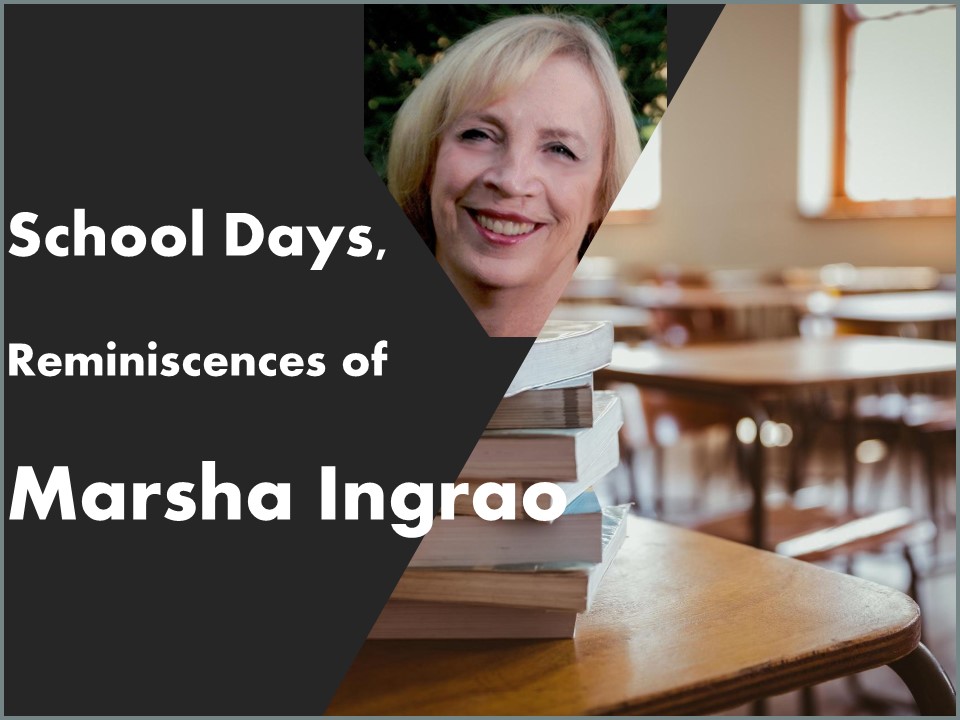
    School Days, Reminiscences of Marsha Ingrao

    Welcome to the School Days, Reminiscences series in which my champion bloggers and authors share reminiscences of their school days. It’s my small way of thanking them for their support and of letting you know about their services and publications.

    This week, I am pleased to introduce Marsha Ingrao, author, blogger, teacher. Marsha and I hit it off as soon as we met, somewhere in the blogosphere. I think our shared backgrounds in and beliefs about education helped cement our friendship. I was delighted when Marsha contributed a guest post on readilearn about Writing in the lower primary classroom, a topic we are both passionate about, last year. I was also honoured when she entrusted me with reading a draft of her WIP Girls on Fire, which I’m looking forward to seeing in print one day.

    Before we begin the interview, I’ve invited Marsha to tell you a little of herself:

    Marsha Ingrao and her books

    My career in education spanned twenty-five years, first as a classroom teacher, then as a math consultant for Migrant Education, and finally the County Office of Education in the area of history-social science.

    Publications include various poems in anthologies, curriculum written as part of my consultant duties, and two published books, Images of America:  Woodlake by Arcadia Publishing and So You Think You Can Blog? by Lulu Press.

    Fiction is still on my bucket list. Two manuscripts I have completed, but not published are:

    • Girls on Fire, a fiction novel about three women in their 50s and 60s who are looking for new love and a change in life.
    • Winning Jenny’s Smile, a middle school fiction about Jenny’s first months in a new school.

    For the past seven years, I have sporadically kept three blogs, TC History Gal Productions about local history, Traveling and Blogging Near and Far, and Always Write about hobby blogging, writing and photography. I manage social media for several non-profits and am an active volunteer in Kiwanis. 

    Welcome, Marsha.

    Now let’s talk school. First, could you tell us where you attended school?

    I attended five schools in Indianapolis, Indiana through my junior year of high school, then moved with my mother and brother to Portland, Oregon to finish high school at Madison High. I attended one year of college at Portland State University and finally finished my education with a master’s degree and administrative credential over twenty years and two states later from Fresno Pacific University.

    Did you attend a government, private or independent school?

    Except for the short stint to finish my master’s degree my schooling was all public.

    What is the highest level of education you achieved?

    Master’s Degree

    What work or profession did you choose after school and was there anything in school that influenced this choice?

    My career choices, except for education, were as scattered as my education primarily based on how long it took me to finish my degree and my financial constraints in finishing. My mother taught school, and that was my eventual goal as well.

    What is your earliest memory of school?

    Kindergarten was my first experience at school. My grandmother and mother had already taught me most of the things they teach now in kindergarten, but we played in school and having such wonderful play setups and being with so many children was new to me.

    What memories do you have of learning to read?

    I remember Dr. Seuss and Dick and Jane. We did not learn phonetically at first that I remember, but somewhere along the line, someone introduced phonetics. By that time, I read voraciously.

    What memories do you have of learning to write?

    Marsha Ingrao on writing

    Learning to write pained me. I couldn’t see well and probably was dyslexic with a graphic disability, so I didn’t learn to write in cursive, which was wildly important in those days, until I reached the fourth grade. I remember my third-grade teacher took my new fountain pen away because I couldn’t write. Grrr

    My fifth-grade teacher praised my poetry and my father called me Hemist Earningway. I entered writing contests in magazines. Sadly, they responded that I was too young to show any promising talent. That squelched my professional writing career.

    What do you remember about math classes?

    I skipped half of second grade, so my mother prepared me over the summer by teaching me multiplication. When I started third grade, we had timed tests in subtraction. I was number one in music memory tests, but a failure at subtraction timed tests. My father was a design engineer and tried to teach me to use a slide rule when I started algebra in ninth grade. I did not do well in either algebra or learning from my father. Geometry was a bust, but I enjoyed and did well in math after the first two years of high school. I also got contact lenses.

    What was your favourite subject?

    Marsha Ingrao enjoyed learning about the States and other countries

    I liked to research, not that I was thorough compared to the kinds of research students can do today. In fifth and sixth grades we did reports on states and countries. Those were my favorite assignments in grade school. I loved the mathematics of grammar and for some strange reason loved diagramming sentences in junior high school. English was my favorite subject. That’s when I joined the journalism club.

    What did you like best about school?

    Marsha Ingrao liked music and art classes best at school

    I loved music and art classes and was thrilled to learn techniques to draw because seeing something and trying to recreate it on paper baffled my brain as much as using a slide rule. I adored reading but hated giving oral book reports.

    What did you like least about school?

    The bus ride to get there took forty-five minutes when we moved to the suburbs. It wasted time and eliminated after school commitments since my mother didn’t drive until I was in junior high or high school.

    How do you think schools have changed since your school days?

    This is a great question, Norah. The biggest changes, I think, have been instigated by the Civil Rights movement and technology. The opportunities afforded by computers and the internet for research and to write without constraints of visual or mechanical handicaps are like carrying water during a hike in the desert. The emphasis on equity and collaboration rather than competition prepares students for a working environment. Students in our community receive Chromebooks and free internet they can use at home. When we attended school, public schools didn’t even furnish paper, pens, and pencils. Buying a fountain pen was a third-grade status symbol.

    What do you think schools (in general) do well?

    In spite of what the public say about schools, the graduating students I interview have so many opportunities to succeed and far exceed my expectations of what a graduate should be able to do. They have so many choices both in and out of school. Boys and girls can participate equally in sports, theatre, mock trials, history, math, reading, writing, and science competitions. There are academies set up for agriculture, science, math, or the arts where students can specialize if they choose. Our schools also add the requirement of community service.

    How do you think schools could be improved?

    Marsha Ingrao says how schools could be improved

    These questions made me think about how much schools have improved. We complain that kids can’t write, and indeed, texting has changed the way kids think. Capitalizing the word I is not important to them but is to educators. Communicating quickly is something kids have taken to a new level. What they don’t know how to do is think beyond the immediate. Just because they can communicate doesn’t mean that they do it well. Schools need to challenge students to step back to imagine the bigger picture and consider the consequences of their actions. This is why teaching social studies and humanities is essential.

    thank you for your participation

    Thank you for sharing your reminiscences of school and thoughts about education in general, Marsha. It’s been wonderful to have you here. I learned so much I didn’t already know about you. I especially love that your father called you Hemist Earningway and hope that writing is an earning way for you. However, I am very disappointed in the response of magazines that had such a negative impact on your ambitions and potential.

    Find out more about Marsha Ingrao on her blogs

    TC History Gal Productions

    Traveling and Blogging Near and Far

     Always Write

    Connect with her on social media

    FB Page

    Twitter: @MarshaIngrao

    Pinterest

    Instagram

    Purchase a copy of Images of America:  Woodlake by Arcadia Publishing

    or receive a free copy of So You Think You Can Blog? by Lulu Press.


    If you missed previous reminiscences, check them out here:

    Charli Mills

    Sally Cronin

    Anne Goodwin

    Geoff Le Pard

    Hugh Roberts

    Debby Gies

    Pauline King

    JulesPaige

    D. Avery

    Christy Birmingham

    Miriam Hurdle

    Robbie Cheadle

    Look for future interviews in this series to be posted on Sunday evenings AEST.
    Coming soon:

    Ritu Bhathal

    Joy Lennick

    Darlene Foster

    Susan Scott

    Mabel Kwong

    Sherri Matthews

    Chelsea Owens

    Pete Springer

    with more to follow.

    Thank you blog post

    Thank you for reading. I appreciate your comments. Please share your thoughts.


  • Interview with Anne Donnelly, author-illustrator – readilearn

    Interview with Anne Donnelly, author-illustrator – readilearn

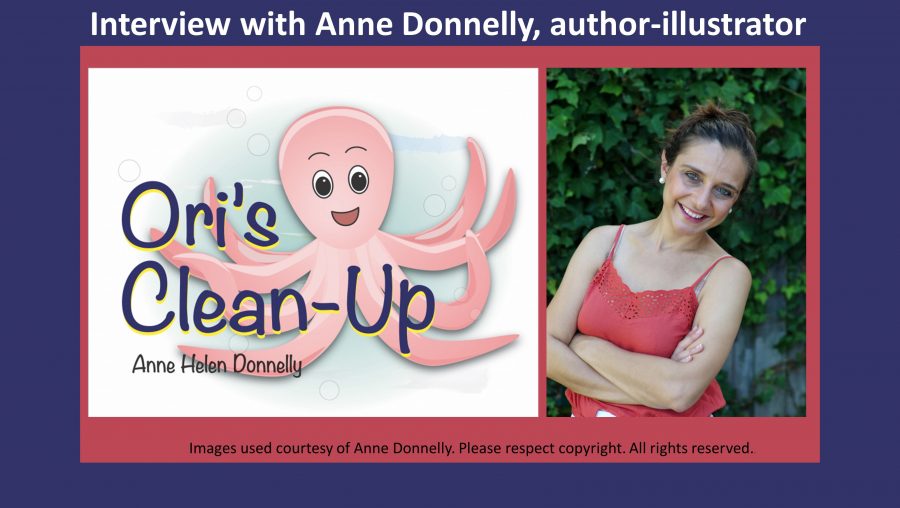
    With tomorrow 8 June World Oceans Day and World Environment Day just a few days ago on 5 June, there is no better time than now to introduce you to Anne Donnelly and her delightful picture book Ori’s Clean-up.

    The aim of World Oceans Day is to celebrate, protect and conserve the world’s oceans. The 2019 theme Together we can protect and restore our ocean focuses on preventing plastic pollution.  With its environmental theme incorporating recycling and re-using, Anne’s book is a perfect fit.

    About Anne Donnelly

    Anne lives in Sydney with her husband, her two children and their new puppy that chews everything! She loves to be creative in all sorts of ways. She loves to read, write, craft and is a very animated storyteller. As a little girl, she used to draw on the underside of the kitchen table and all the way up the stairs, on each step, much to her parent’s shock.

    She has released three books in the Ori Octopus series; Ori the Octopus and Ori’s Christmas in 2017. And now she is especially excited about her latest book Ori’s Clean-Up as it combines two of her passions; children’s literacy and care of our environment. This book has been endorsed by Clean Up Australia and is being stocked at various zoos, national parks, museums, visitor centres, aquariums and holiday destinations all over the country.

    About Ori’s Clean-Up

    Ori the Octopus and his friends have left their rubbish everywhere. They tidy up, but it doesn’t work. To keep their home clean and healthy, they need to do something different, something better.

    The Interview

     Hi, Anne. Welcome to readilearn.

     Thanks for inviting me.

    Anne, you tell your stories with words and pictures. When did you know you wanted to be a storyteller and share your stories with others?

    Continue reading: Interview with Anne Donnelly, author-illustrator – readilearn

  • Would you like strawberries with that?

    Would you like strawberries with that?

    Tomorrow, 5 June is World Environment Day. The theme for this year is Air Pollution. According to the World Environment Day website, nine out of ten people breathe polluted air — a frightening statistic. While the most polluted cities may be far from where we live and the effect of our individual actions may seem negligible, the site recommends ways in which we can help reduce air pollution. I’m sure you already do many of these:

    • Use public transport or car sharing, cycle or walk
    • Switch to a hybrid or electric vehicle and request electric taxis
    • Turn off the car engine when stationary
    • Reduce your consumption of meat and dairy to help cut methane emissions
    • Compost organic food items and recycle non-organic trash
    • Switch to high-efficiency home heating systems and equipment
    • Save energy: turn off lights and electronics when not in use
    • Choose non-toxic paints and furnishings

    Carrot Ranch flash fiction challenge strawberries and mint

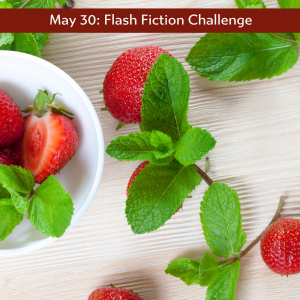
    While not specific to this year’s theme, I thought the flash fiction prompt set by Charli Mills at the Carrot Ranch this week was a perfect match for World Environment Day. Charli challenged writers to In 99 words (no more, no less) write a story that includes strawberries and mint. The combination evokes color contrast, scents, and taste. Where will the combination take you? Go where the prompt leads!

    Growing plants, particularly those that produce edible delicacies, including strawberries and mint, is a great way of introducing children to the importance of caring for the environment. Both strawberries and mint are easy to grow and require little space.

    The rewards are not only in the eating. Children can learn where their food comes from and understand that it doesn’t just appear in plastic packaging on supermarket shelves or in the fridge at home. In caring for a garden, they learn about what plants need and the importance of caring for the soil. They learn to be patient, waiting for the plants to grow and to be ready to harvest. Understandings learned from small-scale gardening, even in a pot, can be applied to caring for the environment on a larger scale. It is never too soon, or too late, to learn.

    In my response to Charli’s prompt, I have considered gardening as nourishment for the mind and spirit as well as the body. Because strawberries are a favourite with both my grandchildren who would probably eat strawberries anywhere and anytime, I settled on a story featuring a grandmother and grandchild. Any similarity to this grandmother is non-existent. I hope you enjoy it anyway.

    (I included some favourite family strawberry desserts in this post.)

    Grandma’s Garden

    Jess blew kisses to Mum, then raced Grandma into the garden. She pulled on her boots and gloves and readied her digging fork. Emulating Grandma, she soaked up explanations of magic combinations that helped plants grow. At the strawberry patch, they filled baskets with ripe red berries. On the way inside, Grandma clipped sprigs of mint.

    They dipped strawberries in chocolate and garnished them with mint.

    “For Jess?”

    “For Mum.

    “Birfday?”

    “Just —”

    Jess inspected the chocolate bowl. “All gone.”

    “Stawbwee?” said Jess, pointing to the remaining few.

    “For Jess,” smiled Grandma.

    Jess munched strawberries and Grandma chewed mint.

    Thank you blog post

    Thank you for reading. I appreciate your feedback. Please share your thoughts.


  • School Days, Reminiscences of Robbie Cheadle

    School Days, Reminiscences of Robbie Cheadle

    Welcome to the School Days, Reminiscences series in which my champion bloggers and authors share reminiscences of their school days. It’s my small way of thanking them for their support and of letting you know about their services and publications.

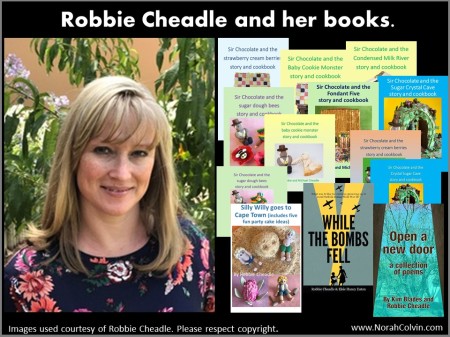
    This week, I am pleased to introduce Robbie Cheadle, author, poet and blogger. I’m not sure when or where I first met Robbie, but I know was captivated by her delightfully unique Sir Chocolate series of picture books which she illustrates with amazing fondant figurines. I was also intrigued to know that these books were jointly written with her and her son Michael, starting from when he was ten years old. There are now six books in the Sir Chocolate series and, since then, Robbie has published a memoir of her mother’s war-time childhood, co-written a book of poems, and had others of her poems and short stories featured in anthologies.

    Robbie Cheadle and her books

    Before we begin the interview, I asked Robbie to tell you a little of herself:

    Robbie, short for Roberta, is an author with six published children’s picture books in the Sir Chocolate books series for children aged 2 to 9 years old (co-authored with her son, Michael Cheadle), one published middle grade book in the Silly Willy series and one published preteen/young adult fictionalised biography about her mother’s life as a young girl growing up in an English town in Suffolk during World War II called While the Bombs Fell (co-authored with her mother, Elsie Hancy Eaton). All of Robbie’s children’s book are written under Robbie Cheadle and are published by TSL Publications. 

    Robbie has recently branched into adult horror and supernatural writing and, in order to clearly differential her children’s books from her adult writing, these will be published under Roberta Eaton Cheadle. Robbie has two short stories in the horror/supernatural genre included in Dark Visions, a collection of 34 short stories by 27 different authors and edited by award winning author, Dan Alatorre. These short stories are published under Robbie Cheadle.

    Robbie has also recently published a poetry collection, Open a new door, together with fellow South African poet, Kim Blades.

    Welcome, Robbie.

    Let’s talk school. First, could you tell us where you attended school?

    I went to fourteen different schools as we moved around a lot. My first school was Craighall Convent in Johannesburg. The school I learned the most at was a bilingual school in George in the Western Cape. I was only there for six weeks but I learned the basics of Afrikaans (second language in South Africa) which I had missed out on before.

    Did you attend a government, private or independent school?

    I attended a mixture of schools. I attended a couple of private schools when I was in primary school including two convents. I went to public schools when we lived in George for the first time and when we lived in Cape Town. I attended a public high school in Johannesburg.

    What is the highest level of education you achieved?

    I have a degree and an honours degree in Accounting as well as my board examinations to become a chartered accountant. I was keen to do an economics degree a few years ago when I wrote my publications on direct foreign investment into Africa but I couldn’t find anything suitable. I reverted to self-study and analysis instead and this research is in my publications.

    What work or profession did you choose after school and was there anything in school that influenced this choice?

    Immediately after school I went to a secretarial college for a year where I learned typing, shorthand and the other skills of a professional secretary. I then worked for a few years and saved money which I used to pay for some of my university education. I attended a correspondence university and worked shifts in a video shop to earn money while I did my first degree. I applied for, and was accepted, for an internship at KPMG in Johannesburg when I finished my degree. KPMG paid for my studies for my honours degree and I studied part time in the evenings and during public holidays and weekends. It was hard but I managed to do it and I passed all my examinations first time around, even my honours degree where I had to pass all nine examinations in one sitting.

    What is your earliest memory of school?

    Robbie Cheadle as a school girl in the news

    I remember having my photograph taken for the national newspaper on the first day of school. My friend’s father was a photographer for the newspaper and he used me as his “First day of school” photograph that year.

    I also remember being left out when the girls (aged 7 years old) when to mass and practiced for their first Holy Communion. I recall being sad that I didn’t have a long white dress and candle. I only took my Holy Communion when I was 12 years old and we were living in George.

    What memories do you have of learning to read?

    I remember being fascinated with books and reading. I can recall sounding out the words by myself and the triumph of reading Little Bear all by myself. Once I got the hang of reading, I just went from strength to strength. I got books for every birthday and Christmas and belonged to the library. When I was 9 years old and we lived in Cape Town, I used to cycle to the library twice a week and take out 7 books at a time to read (4 library cards were mine and 3 were my sister, Cath’s, but she let me use them.)

    What memories do you have of learning to write?

    I remember writing my name in my books and I always inverted by b’s, d’s and p’s. I had a bit of remedial help and this was corrected when I was 8 years old. My old books still have the inscription Roderta Eaton.

    What do you remember about math classes?

    I have very little memory of maths class other than I was able to do reasonably well without much effort which left me lots of time to read. I remember my high school maths teacher writing a remark on my report that said: “Generally speaking, Robbie is generally speaking.” I have always remembered that comment. I had one teacher that told my mom that I had layers like an onion which you needed to peel back to find the real me. My mother was also told by a teacher that I practiced “silent insubordination.”

    Robbie Cheadle discusses what she liked best about school

    What was your favourite subject?

    I enjoyed English firstly and then History. Accounting and Maths were both relatively easy for me and I hated Afrikaans with a passion. My second ever Afrikaans teacher embarrassed me in front of the whole class and I would never bother with learning this language after that.

    What did you like best about school?

    I have two lovely memories of school, one, was creating a play with my friends to perform for the class when I was 8 years old. I loved organizing the cast and teaching them their roles. I have always enjoyed project management and organizing. The other memory I cherish was being chosen to be Mary in the Nativity Play when I was 12-years old. I was simply thrilled.

    What did you like least about school?

    I can’t think of anything I really didn’t like about school; it just was something I did every day for 12 years. I have always been a loner and would always chose books over people. We moved a lot, so I learned not to get too close to other children, it was easier to uproot myself that way. I am still quite good at accepting change and I don’t retain long-term physical friendships. I prefer my virtual friends who are constant and always there.

    How do you think schools have changed since your school days?

    Unfortunately, the quality of the public education in South Africa for underprivileged children has not improved much since 1994. Lots of children start learning English late in their school career (at the age of 10 or 11 years old) and it is difficult for them to cope with being taught in English.

    There is still a huge shortage of school basics in many rural schools and children are still being taught under trees and in classes with few desks and chairs and even fewer learning materials. There are often no proper toilets for the children to use.

    I belong to charities which donate books and stationery to underprivileged schools. A lot is done to help by the private business sector and individuals.

    My sons both attend private schools and the college my older son attends is exemplary in its out-reach programme. It supports a disadvantaged college in a rural area and has a programme to train teachers from disadvantaged backgrounds. It also has a programme to help disadvantaged children with potential to achieve at school. This is run in the afternoons and the teaching staff freely give of the own time and skills. It is a sad that the public education is poor because our world is evolving into one where higher-level skills are becoming vital to get and retain jobs. English and maths skills are essential.

    What do you think schools (in general) do well?

    I can only answer this question from the point of view of my own sons. Both of their schools have outcomes-based education programmes and this works so well. Their curriculums are marvelous and I often find myself thinking how much I would have enjoyed their schooling when I was a girl. My older son’s school has programmes to give accelerated learning opportunities to boys who find learning easier and support programmes for boys that find some areas of learning more difficult. They just do such wonderful things, read fantastic books and have marvelous learning opportunities. Of course, as with all things in life, you have to grasp opportunities or else they pass you by.

    How do you think schools could be improved?

    The most important thing in our government schools is to get good teachers. Teachers that aren’t masters in their subject will struggle to teach others, particularly, children that can’t learn in one specific way but need the information presented in another way. The children also need a safe learning environment, which often isn’t the case, and basic learning materials.

    thank you for your participation

    Thank you for sharing your reminiscences of school and thoughts about education in general, Robbie. It was interesting to hear the comparisons between your own schooling and that of your son’s current schooling. I was interested to hear your response to learning Afrikaans and was surprised at how late English was taught. The photographs of you from the newspaper are very cute and to be treasured.

    Find out more about Robbie Cheadle on her blogs

    Bake and Write

    Robbie’s inspiration

    And her Goodreads author page:


    Connect with her on social media

    Facebook @SirChocolateBooks

    Roberta Writes

    Twitter @bakeandwrite

    @robertaeaton17

    Robbie’s books can be purchased from

    Amazon

    Or

    TSL Publications

    If you missed previous reminiscences, check them out here:

    Charli Mills

    Sally Cronin

    Anne Goodwin

    Geoff Le Pard

    Hugh Roberts

    Debby Gies

    Pauline King

    JulesPaige

    D. Avery

    Christy Birmingham

    Miriam Hurdle

    Look for future interviews in this series to be posted on Sunday evenings AEST.

    Coming soon:

    Marsha Ingrao

    Ritu Bhathal

    Joy Lennick

    Susan Scott

    Mabel Kwong

    Sherri Matthews

    Chelsea Owens

    Pete Springer

    with more to follow.

    Thank you blog post

    Thank you for reading. I appreciate your comments. Please share your thoughts.


  • #WATWB Repaying the debt forward

    #WATWB Repaying the debt forward

    On the last Friday of each month We Are the World Blogfest invites bloggers to join together in promoting positive news. If you would like to join in, please check out the rules and links below.

    This month I am sharing a story of a philanthropist who paid off the college loans for almost 400 students at an estimated cost of approximately $US40 million. All that Robert F. Smith (a self-made millionaire through investments in technology) asked of the students was that they “pay it forward”.

    Click to read the whole article:

    Billionaire to pay off entire graduating class’s student debts

    As stated by #WATWB, “There are many an oasis of love and light out there, stories that show compassion and the resilience of the human spirit. Sharing these stories increases our awareness of hope in our increasingly dark world.”

    I think the world could do with some more light at the moment. Please join in and share positive stories to lift the clouds.

    Here are the guidelines for #WATWB:

    1. Keep your post to Below 500 words, as much as possible.

    2. Link to a human news story on your blog, one that shows love, humanity, and brotherhood. Paste in an excerpt and tell us why it touched you. The Link is important, because it actually makes us look through news to find the positive ones to post.

    3. No story is too big or small, as long as it Goes Beyond religion and politics, into the core of humanity.

    4. Place the WE ARE THE WORLD badge or banner on your Post and your Sidebar. Some of you have already done so, this is just a gentle reminder for the others.

    1. Help us spread the word on social media. Feel free to tweet, share using the #WATWB hashtag to help us trend!

    Tweets, Facebook shares, Pins, Instagram, G+ shares using the #WATWB hashtag through the month most welcome. We’ll try and follow and share all those who post on the #WATWB hashtag, and we encourage you to do the same.

    The co-hosts for this month are: 

    Damyanti Biswas,
    Simon Falk,
    Shilpa Garg,
    Mary J. Giese ,
    and Dan Antion.

    Please pop over to their blogs to read their stories, comment and share.

    Click here to join in and enter the link to your post. The bigger the #WATWB group each month, the greater the joy!

    Thank you blog post

    Thank you for reading. I appreciate your comments. Please share your thoughts.
  • Ice on the rocks

    Ice on the rocks

    This week at the Carrot Ranch, Charli Mills discusses her daughter’s existence in the treeless landscape in the northernmost town in the world, Longyearbyen on Svalbard, Norway.

    This video provides an introduction to Longyearbyen.

    In her post, Charli warns that “The reality of climate change impacted the polar regions of our world first. Think of the Arctic as our canary in the coal mine … To say the Arctic is the canary means that our planet is changing so rapidly that species are dying.”

    Evidence of those changes is discussed in this recent National Geographic article

    and, while this video shows the changes to the Arctic sea ice from 1979 – 2018,

    (Read information accompanying this video here.)

    this article shows the situation updated to April 2019.

    With the effects so evident, it is hard to fathom that there are still some who deny the climate is changing. To what end?

    The phrase ‘on the rocks’ often refers to a beverage, usually alcoholic, served undiluted on ice. It can also refer to something in difficulty or failing. It was a combination of these meanings, minus the alcohol, I used in the title.

    Charli Mills' flash fiction challenge Ice

    Charli’s discussion introduced her flash fiction challenge to In 99 words (no more, no less) write a story without ice. It can be a world without ice or a summer camp that runs out of cubes for lemonade. What does the lack mean to the story? Go where the prompt leads!

    I took it a little differently.

    Let’s Hear it for Ice

    A world without ice —

    That made me think tw—

    Two times.


    A world without ice

    Would not be so n—

    Pleasant.


    We couldn’t play games

    With a six-sided d—

    Numbered cube.


    We couldn’t have fries

    With a side-serve of r—

    Food grain.


    Our food would be bland

    Without pinches of sp—

    Flavour.


    A world without ice

    Where rule is by v—

    Badness.


    A world without ice

    We’d all pay the pr—

    Cost.


    A world without ice

    I’d say in a tr—

    Moment.


    A world without ice

    I’d even say thr—

    Three times


    Would never

    Could never

    Be anything nice!

    Thank you blog post

    Thank you for reading. I appreciate your feedback. Please share your thoughts.

  • School Days, Reminiscences of Miriam Hurdle

    School Days, Reminiscences of Miriam Hurdle

    Welcome to the School Days, Reminiscences series in which my champion bloggers and authors share reminiscences of their school days. It’s my small way of thanking them for their support and of letting you know about their services and publications.

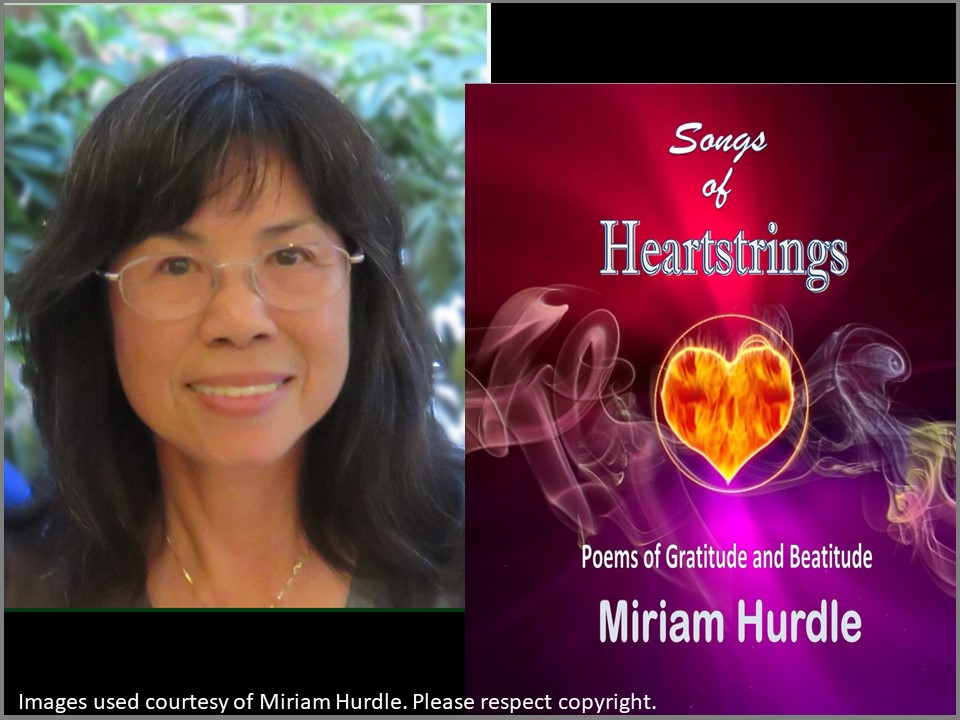
    Miriam Hurdle, poet

    This week, I am pleased to introduce Miriam Hurdle, poet, blogger, flash fiction writer, photographer, ex-teacher and educator. She blogs at the Showers of Blessings and recently published a book of poems entitled Songs of Heartstrings: Poems of Gratitude and Beatitude.

    I first met Miriam at the Carrot Ranch when she rode up and joined in the flash fiction challenges. Since then, we’ve met up in many different places around the blogosphere. Considering she’s been blogging even longer than I; I’m surprised we hadn’t met earlier. We share our thoughts on education and grandchildren, and in fact on anything to do with making our journeys through life the best we can. It is always a pleasure to converse with Miriam.

    Before we begin the interview, I invite Miriam to tell you a little of herself:

    Miriam Hurdle is a multi-genre writer. She writes poetry, flash fiction, short stories and memoir.

    Music has rooted in her life. Being a soloist as a teenager led her to taking voice lessons and to have ongoing singing engagements. She continues to sing soprano in choral groups. Lyrics have a major influence in the natural flow of her melodic writing. She writes memoir in the form of poetry.

    She took photos when the films were black and white. Photography is still her enjoyable hobby. Drawing and painting were fun activities as a child. She resumed drawing and watercolor painting several years ago. In her poetry collection, she includes photos and paintings to illustrate the poems.

    She earned a Doctor of Education from the University of La Verne in California. After two years of rehabilitation counseling, fifteen years of public-school teaching and ten years in school district administration, she retired and enjoys life with her husband in southern California. She makes frequent visits to her daughter, son-in-law and granddaughter in Oregon.

    Welcome, Miriam.

    Let’s talk school. First, could you tell us where you attended school?

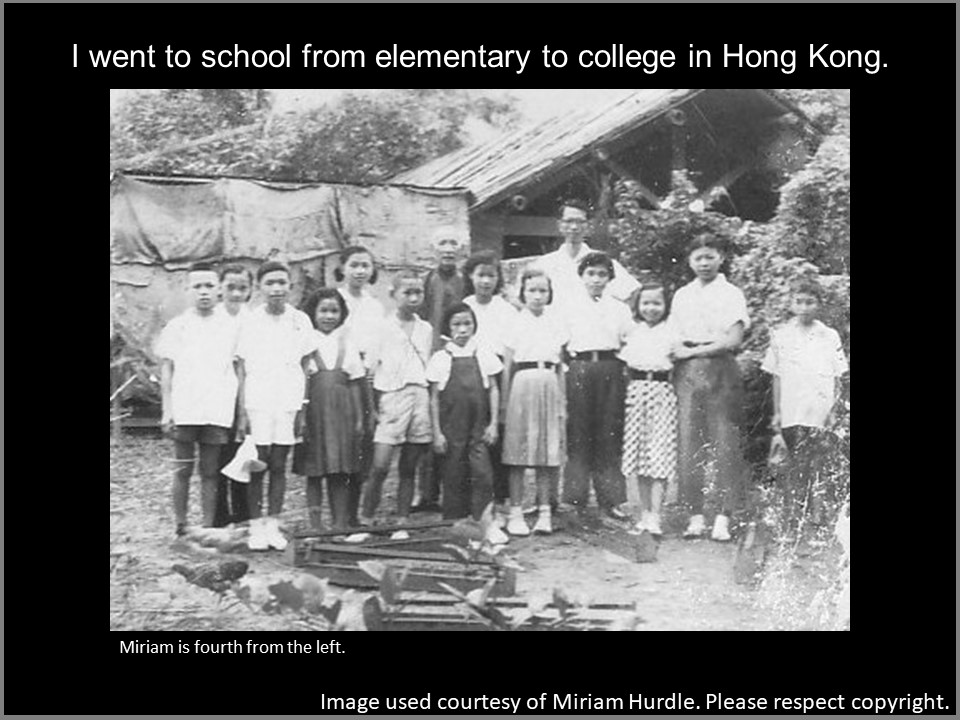
    Miriam Hurdle school photo

    I went to school from elementary to college in Hong Kong.

    Did you attend a government, private or independent school?

    In Hong Kong, there are public schools, government subsidized schools, and private schools. I attended two elementary schools sponsored by organizations and they were tuition free schools. One was a Buddhist organization sponsored school, and we had to take a Buddhism class. I remember the nun chanting in class.

    What is the highest level of education you achieved?

    After I graduated from the college in Hong Kong, I worked for five years, then came to the United States for my graduate studies. I got three master’s degrees – in Religious Education, Counseling, and Educational Administration and a Doctor in Education.

    What work or profession did you choose after school and was there anything in school that influenced this choice?

    I love music since I was a kid. I sang solos in churches as a teenager. As a result, I took voice lessons and had more singing engagement. It would be my first choice to become a professional musician or teach music, but I could only afford to do music as an enjoyment, not a profession.

    When I was in college, I volunteered in Far East Broadcasting Company in several programs. I did singing and recorded children’s stories. When I finished college, FEBC wanted to hire me full time, but the job didn’t pay too much.

    Many girls chose to be teachers or nurses back in those days. I accepted a teaching job. I taught Chinese as a Second Language for three years in the Baptist University of Hong Kong. I was also a Director of Children’s Department for two years at Asian Outreach where I wrote four children’s books.

    In the U.S. I worked as a Rehabilitation Counselor for two years, taught preschool for two years, taught elementary school for fifteen years, and worked as a school district administration for ten years.

    What is your earliest memory of school?

    My earliest memory was when I won the Abacus Competition in first grade. The second-grade teacher taught abacus. He came to our classroom to present me the award. Another wonderful memory was that my first-grade teacher Mrs. Leung said I was bright. The thought of being bright influenced my whole life.

    When I studied counseling and child development, I learned that positive reinforcement encourages desirable behavior. In fact, it is also true with adults. Instead of pointing fingers or saying, “don’t do this, don’t do that,” we can praise and encourage desirable behavior or responses.

    What memories do you have of learning to read?

    We did a lot of memorization in reading. We had to recite the reading lessons in early elementary school. My dad helped with my homework and had me memorized the lessons every week. I learned everything in the current lesson before the teacher taught a new lesson. At the fourth grade, I read my dad’s newspapers. My dad and I traded sections to read. I read the horrible news describing the details of crime scenes, read adult fantasy, comic strips and the Sunday children’s section.

    My favorite literature was Aesop’s Fables. I also remember learning English grammar such as the regular tenses as walk, walking, walked, walked; and the irregular tenses as go, going, went, gone.

    What memories do you have of learning to write?

    There was not a lot of creative writing in the lower grades in elementary school. We did a lot of copying the reading lessons. I guess by copying; we remember writing in a proper sentence structure. In upper grade, I learned how to write a story with an opening, the middle, the climax and the conclusion. I remember how I paced my writing and made sure the climax was at the three fourth of the paper. We had a subject in Letter Writing and learned to write different letters.

    I learned to write both Chinese and English calligraphy. For Chinese, we wrote in vertical and right to left progression. For English, we wrote alphabet and spellings. I like calligraphy and I still write in calligraphy style in my handwriting. I bought a calligraphic set to address my daughter’s wedding invitations.

    What do you remember about math classes?

    We learned math the traditional way and learned the mental math. I did addition and subtraction well with an abacus. Doing multiplication and subtraction on the abacus is harder so I don’t remember how to do them. I won the Abacus Competition in the first grade.

    What was your favorite subject?

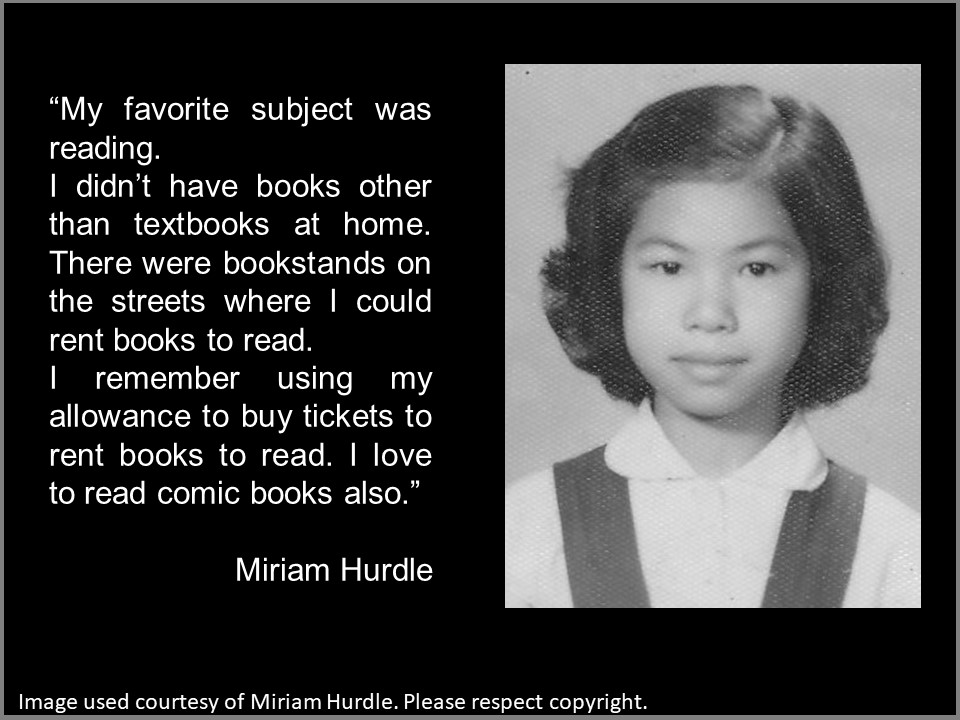
    Miriam Hurdle's favourite subject at school was reading

    My favorite subject was reading. I didn’t have books other than textbooks at home. There were bookstands on the streets where I could rent books to read. I remember using my allowance to buy tickets to rent books to read. I love to read comic books also.

    What did you like best about school?

    I like to be with my friends. My best friend Shirley at the fourth grade was my teacher Mrs. Cheung’s daughter. Mrs. Cheung was also a music teacher for the upper grades. We had a singing contest. I entered the competition and got fourth place. Shirley got second place. Shirley played the piano. I went to her house on the weekends and listened to her play for hours.

    I keep in touch with Shirley. When we traveled to London, she and her husband took us sightseeing for five days.

    What did you like least about school?

    I can’t think of anything I didn’t like. There were forty students in each class. We received two report cards a year; they showed our ranking among the class. I got second to ninth places from first to sixth grade. It broke my heart when I got the ninth place. I can’t remember what happened, but it wasn’t because of any subject.

    How do you think schools have changed since your school days?

    I think the elementary schools in Hong Kong still do a lot of memorization rather than creative learning. My sister and her husband sent their two children to Canadian system International School, and they eventually migrated to Canada. After they got the Canadian citizenship, because of my brother-in-law’s health issue, they went back to Hong Kong and keep the dual citizenship.

    What do you think schools (in general) do well?

    Since I left Hong Kong forty years ago, I can’t comment about the schools there anymore. But I taught in California thirty years ago, I can comment on the schools in California.

    Class size–Kindergarten is 20 students, first to third grades is 25 or fewer students, and fourth to sixth grades is up to 35 students average.

    Schools get special funding for English learners to get extra help to learn at their current English levels to catch up with the levels of their classes.

    There is special funding to help students from the low-income family because statistic shows that these students have low academic levels.

    Many families can afford to send their children to go to preschool. For low-income families, they can send their children to the Headstart program to prepare for the kindergarten.

    There are breakfast and lunch served at schools. Low-income families receive free meals for their children. Other children have meals for reduced or full fees. Students can bring their lunches to school also.

    How do you think schools could be improved?

    At elementary school, there is not enough time of the day to teach all the subject to prepare the students for Junior High or High school. Schools end at 2:30 p.m. for lower grade and 2:45 p.m. for upper grade. For lower grades, teachers teach reading and math in the morning. After lunch, they may teach social studies and physical education. There is no time to teach science. Since the State test at the end of the year doesn’t test science, the teachers give up on teaching that subject.

    For upper grade, teachers teach reading and math in their homeroom. Some of them team teach social studies and science so the teacher could do the preparation and teach for more than one class. Students can benefit more learning if the school days are longer.

    thank you for your participation

    Thank you for sharing your reminiscences of school and thoughts about education in general, Miriam. It’s been wonderful to have you here. I learned so much about you. I am impressed by your doctorate degree, curious about whether you learned English at school, fascinated by the thought of renting books and envious of your singing ability.

    Find out more about Miriam Hurdle

    Visit her website: https://theshowersofblessings.com

    Or her Amazon Author Page: https://www.amazon.com/Miriam-Hurdle/e/B07K2MCSVW?ref=dbs_p_ebk_r00_abau_000000

    Connect with her on social media

    Twitter: https://twitter.com/mhurdle112

    Facebook: https://www.facebook.com/miriam.hurdle.1

    Purchase Songs of Heartstrings from

    Amazon Universal Link: http://smarturl.it/SongsofHeartstrings

    Amazon UK Link: http://www.amazon.co.uk/dp/B07K1S47W9 

    Amazon.com Link: http://www.amazon.com/dp/B07K1S47W9 


    If you missed previous reminiscences, check them out here:

    Charli Mills

    Sally Cronin

    Anne Goodwin

    Geoff Le Pard

    Hugh Roberts

    Debby Gies

    Pauline King

    JulesPaige

    D. Avery

    Christy Birmingham

    Look for future interviews in this series to be posted on Sunday evenings AEST.

    Coming soon:

    Robbie Cheadle

    Marsha Ingrao

    Susan Scott

    Mabel Kwong

    Sherri Matthews

    with more to follow.

    Thank you blog post

    Thank you for reading. I appreciate your comments. Please share your thoughts.


  • National Reconciliation Week in the classroom – readilearn

    National Reconciliation Week in the classroom – readilearn

    Next week, from 27 May until 3 June is National Reconciliation Week. It follows National Sorry Day which is observed on 26 May each year.  The theme for National Reconciliation Week this year is “Grounded in Truth. Walk Together with Courage.”

    With Aboriginal and Torres Strait Islander histories and cultures one of the cross-curricular priorities of the Australian Curriculum, this is a perfect time to ensure enough is being done to provide “the opportunity for all young Australians to gain a deeper understanding and appreciation of Aboriginal and Torres Strait Islander histories and cultures, deep knowledge traditions and holistic world views.”

    Teachers are supported in delivering the curriculum with a richness of information on the National Reconciliation Week website and teaching resources on the Reconciliation Australia Narragunnawali website. Narrangunnawali is a comprehensive resource with much to explore and implement, including RAPS (Reconciliation Action Plans), Professional Learning, Curriculum Resources and Awards.

    Narragunnawali: Reconciliation in Schools and Early Learning

     Additional resources

    Little J and Big Cuz, an animated series for early years children (K – 2). The series is about Little J, who’s five, and Big Cuz, who’s nine. They


    Continue reading: National Reconciliation Week in the classroom – readilearn